The ROI of Light: How Much Can an LED Retrofit Save Your Business?
December 24, 2025
Navigating Commercial Lighting Rebates in Ontario: A 2026 Guide
December 29, 2025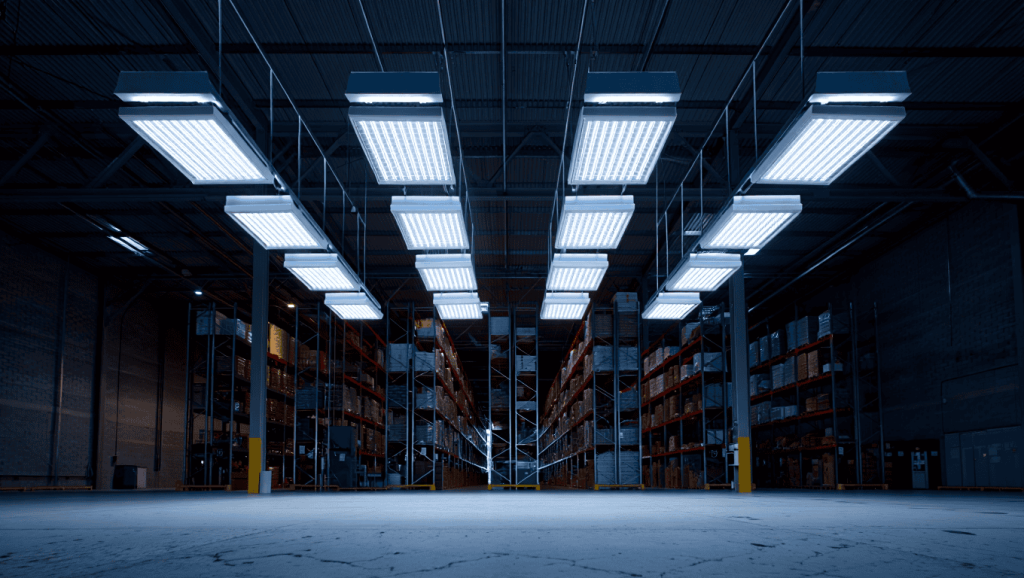
In the world of industrial facility management, not all ceilings are created equal. Whether you are managing a high-density distribution center with narrow aisles or a sprawling open-concept manufacturing plant, the “hero” of your infrastructure is your high bay led fixtures. As of 2025, the technology behind these fixtures has advanced significantly.
With the introduction of the DLC SSL V6.0 technical requirements, high bay LED are now achieving efficiencies that were unthinkable even five years ago. However, choosing the wrong style of fixture can lead to “hot spots,” wasted energy, and dangerous dark zones. Here is how to choose the right high bay “hero” for your facility.
Round (UFO) High Bays: The Open-Space Powerhouse
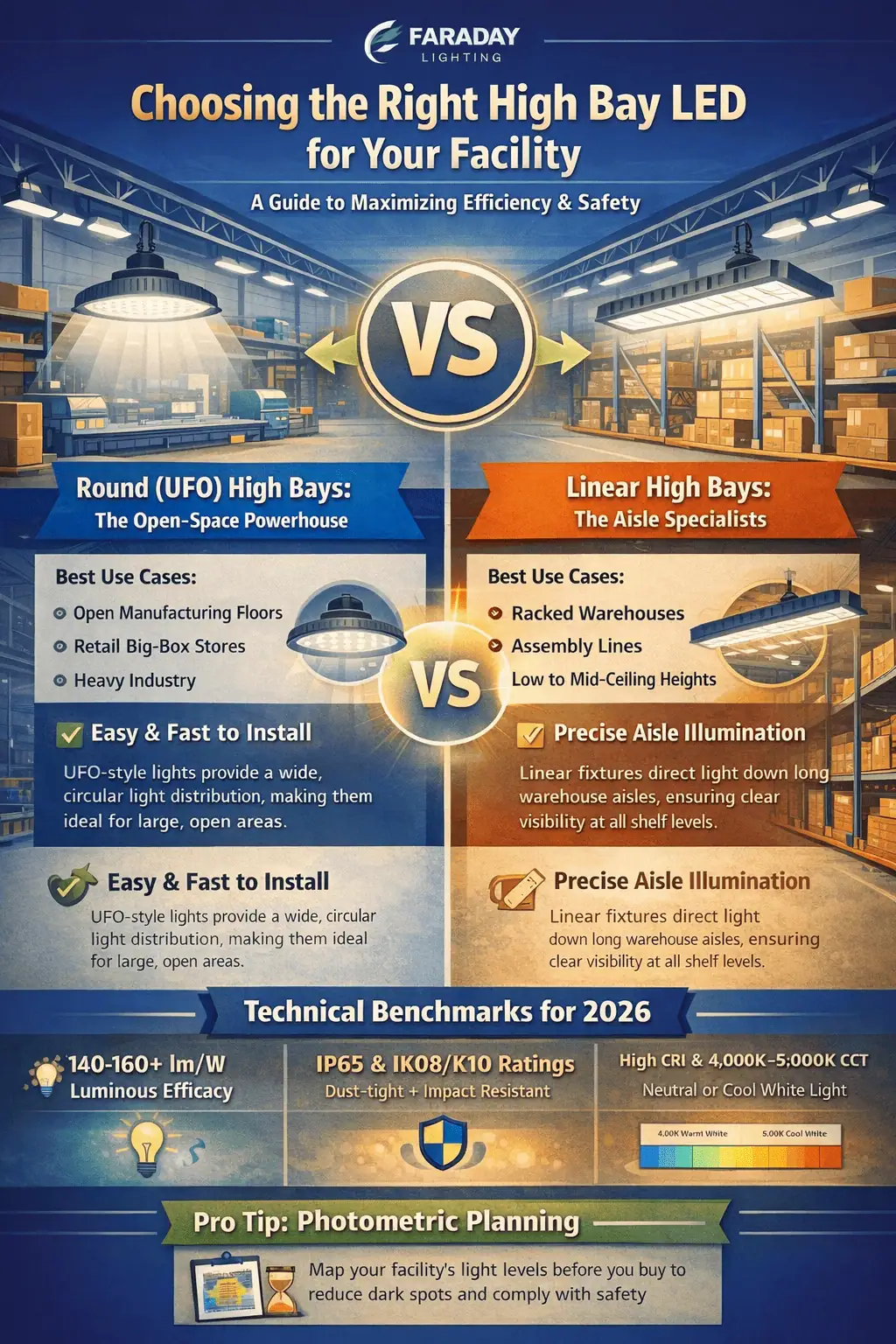
Named for their distinct saucer-like shape, UFO LED High Bays have become the industry standard for general industrial applications. Best Use Cases:
- Open Manufacturing Floors: UFO fixtures provide a circular light distribution (typically 120 degrees), making them ideal for large, square, or open areas where uniform light is required across the entire floor.
- Retail Big-Box Stores: Designers and facility managers often prefer their sleek, modern aesthetic in “industrial-chic” retail environments and gymnasiums.
- Heavy Industry: Because many UFO models feature robust die-cast aluminum housings and integrated heat sinks, they excel in environments with high vibration or dust.
The Advantage: UFO high bays are generally easier and faster to install. They typically feature a single-point hook or pendant mount, which can significantly reduce labor costs during a large-scale retrofit.
Linear High Bays: The Aisle Specialists
While UFOs dominate open spaces, Faraday Linear LED High Bays are the undisputed kings of the warehouse aisle. These rectangular fixtures mimic the footprint of traditional T5 or T8 fluorescent high bays while delivering massive performance gains.
Best Use Cases:
- Racked Warehouses: In facilities with tall pallet racking and narrow corridors, a circular light pattern (UFO) wastes light on top of the racks. Linear fixtures distribute light in a rectangular pattern, pushing the illumination down into the aisles where workers and forklift operators need it most.
- Assembly Lines: The elongated light source reduces shadows, providing a more consistent “task light” feel for workers on a production line.
- Low to Mid-Ceiling Heights: Linear fixtures often provide a softer, more diffused light, making them comfortable for facilities with ceilings in the 15-25 foot range.
The Advantage: Linear fixtures allow for precise light placement. By aligning the fixture with the aisle, you achieve higher “vertical foot-candles,” ensuring that labels on the bottom and top shelves are equally legible.
Technical Benchmarks for 2026: What to Look For
When reviewing spec sheets for your next upgrade, pay close attention to these three performance metrics to ensure you are getting a future-proof product:
- Luminous Efficacy (lm/W): In 2026, do not settle for anything less than 140-160 lumens per watt. Higher efficacy means you get the same brightness for lower wattage, directly impacting your monthly utility bill.
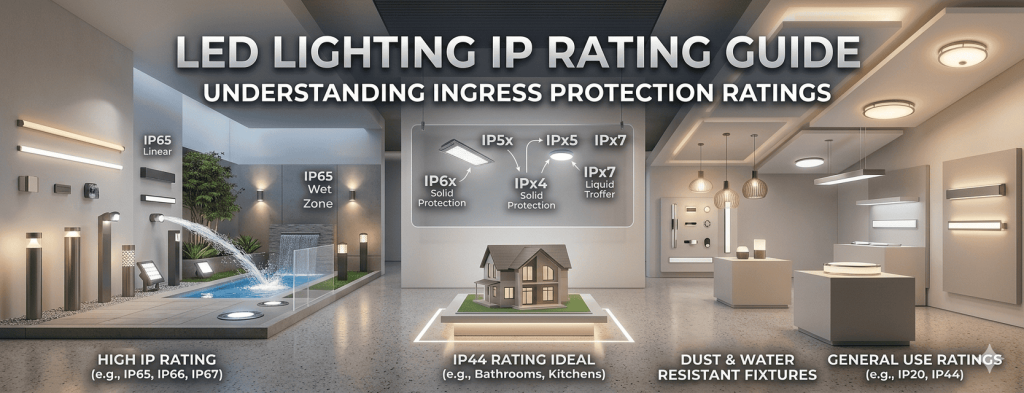
- IP & IK Ratings: For industrial environments, look for an IP65 rating (dust-tight and water-resistant) and an IK08 or IK10 rating (impact resistance). This ensures your investment survives accidental strikes from equipment or harsh cleaning protocols.
- CCT and CRI: * 4000K (Neutral White) is ideal for general warehousing to reduce eye strain.
- 5000K (Cool White) is better for high-detail inspection areas or shipping docks where alertness is key.
- CRI 80+ is now the standard for ensuring colours (and safety labels) are represented accurately.
The Importance of Photometric Planning
You wouldn’t build a warehouse without a blueprint; you shouldn’t install lighting without a photometric simulation. A common mistake is a “one-for-one” replacement, simply putting a new LED where an old Metal Halide used to be.
Because LEDs are highly directional, this can create “cave effects” or uneven lighting. At Faraday Lighting, we map your facility’s “foot-candle” levels using advanced software before turning a single screw. This ensures that:
- Safety standards are met: Adhering to Ontario’s OHSA and IESNA recommendations for minimum light levels.
- Efficiency is maximized: Identifying areas where you might actually need fewer fixtures than you currently have.
Conclusion: Matching the Tool to the Task
Choosing between UFO and Linear high bays isn’t about which light is “better”; it’s about which tool fits your facility’s geometry. UFOs bring raw power and easy installation to open floors, while Linear fixtures bring surgical precision to the racks and aisles.
Still not sure which “hero” your facility needs? Faraday Lighting offers expert consulting and high-performance fixtures tailored to Canada’s industrial sector. We help you choose the right optics, wattages, and mounting styles to maximize both safety and savings.
Request Your Free Facility Audit & ROI Analysis Today
FAQs
1. Should I choose UFO or linear high bay lights for my warehouse?
It depends on your layout. UFO high bays work best in open areas where wide, circular light distribution is needed. Linear high bays are better for racked warehouses and narrow aisles because they direct light precisely down the aisle, reducing shadows and wasted illumination.
2. What ceiling height is ideal for UFO vs. linear high bay LEDs?
UFO high bays typically perform best in facilities with ceilings above 25 feet, such as open manufacturing floors or distribution centers. Linear high bays are ideal for low to mid-height ceilings between 15–25 feet, where controlled, even lighting is critical for visibility and comfort.
3. Why is photometric planning important for high bay lighting upgrades?
Photometric planning ensures proper light levels across your facility before installation. It prevents dark zones, glare, and over-lighting while helping you meet safety standards and reduce fixture count, energy use, and long-term operating costs.
4. What efficiency standards should high bay LED lights meet in 2026?
Modern high bay LEDs should deliver at least 140–160 lumens per watt, carry an IP65 rating for dust and moisture protection, and have IK08 or IK10 impact resistance. These benchmarks ensure durability, energy savings, and long-term performance in industrial environments.
5. What colour temperature is best for industrial high bay lighting?
For most warehouses and manufacturing spaces, 4000K provides balanced, low-strain illumination. 5000K is better suited for inspection areas, shipping docks, and tasks requiring higher alertness. A CRI of 80+ ensures accurate colour rendering for safety labels and signage.