

My Parking Lot Lights Keep Burning Out

What Does DLC Certification Mean & Why Does It Matter?
February 17, 2026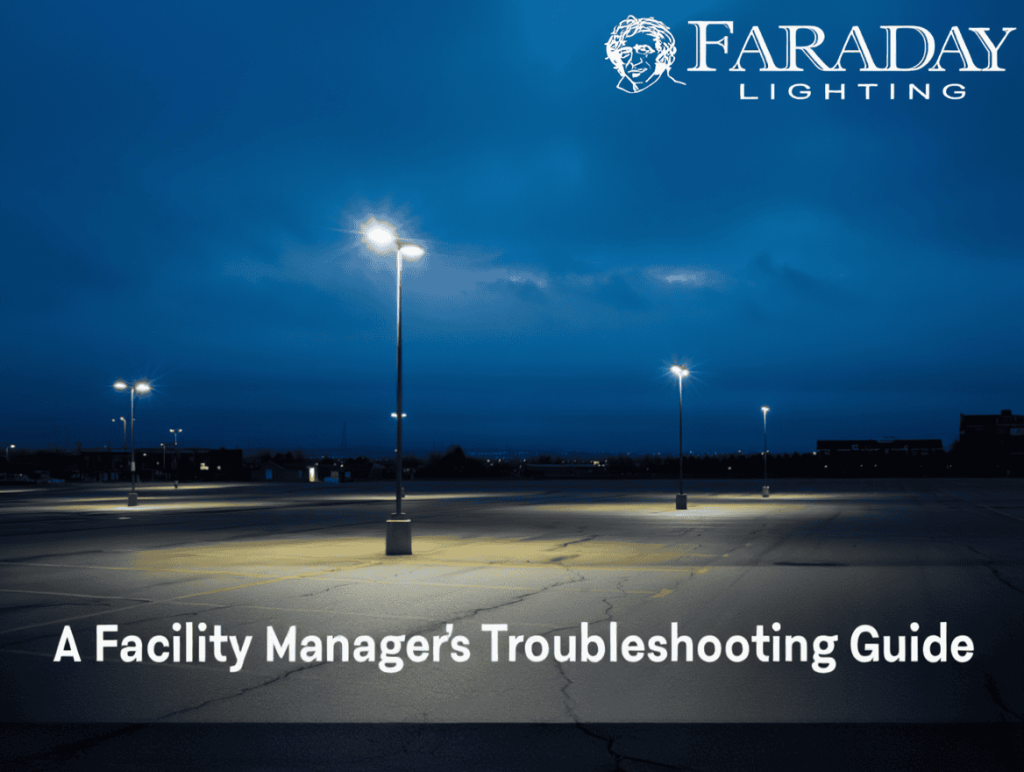
If your parking lot lights keep burning out, it’s often a sign of deeper issues such as outdated fixtures, voltage fluctuations, poor heat management, or low-quality bulbs. Constant replacements not only increase maintenance costs but also leave your property poorly lit, creating safety and security concerns. Upgrading to reliable, energy-efficient LED parking lot lighting can solve the problem, reduce downtime, and provide consistent illumination for years to come.
After completing over 500 commercial and industrial lighting projects across Ontario, our team at Faraday Lighting has seen every variation of this problem. In most cases, the recurring failure traces back to one of five specific causes — none of which are solved by simply replacing the burnt-out fixture with the same model.
Why Parking Lot Lights Keep Burning Out (and How to Fix It)
This guide walks through cause you parking lot lights keep burning out, how to diagnose it on-site, and what a permanent fix looks like.
Cause #1: The Wrong Fixture for the Canadian Climate
This is the single most common cause of premature failure in Ontario parking lots, and it’s entirely preventable. Most budget fixtures sold through wholesale distributors are rated for general outdoor use — not for the freeze-thaw cycles, road salt spray, and -30°C wind chills that define a Southern Ontario winter.
When water infiltrates an unsealed housing, freezes, expands, and then thaws repeatedly across a single season, it degrades driver components and LED boards faster than any operating hour count would suggest.
How to diagnose it:
- Fixtures fail in clusters during or immediately after winter, then stabilize in summer
- Rust staining or moisture tracks are visible inside the lens housing
- Corrosion on wire connections or mounting hardware
The fix:
Specify fixtures rated IP65 or higher for any exposed parking lot or exterior wall application. For sites near road salt exposure — driveways, loading docks, ground-level wall packs — IP66 is the safer standard. Also, verify IK08 or higher impact resistance if the site has vehicle proximity.
| IMPORTANT NOTE: Canadian Standards Association (CSA) certification is not the same as weatherproofing. Always check the IP rating on the fixture spec sheet, not just the compliance markings. |
Cause #2: Cheap or Mismatched LED Drivers
The driver is the component that converts incoming AC power to the low-voltage DC current that LEDs require. It is also the component that fails first in the vast majority of premature LED outages — not the LED chips themselves.
Budget fixtures frequently ship with drivers rated for 50,000 hours on paper, but tested only under ideal laboratory conditions (stable 25°C, clean power, no voltage fluctuations).
Ontario’s commercial grid, particularly in industrial areas and older plazas, regularly delivers voltage spikes and harmonic distortion that destroy underpowered drivers within 12 to 18 months.
How to diagnose it:
- Fixtures dim noticeably before they fail completely (driver degradation, not LED failure)
- Failure concentrated on a single circuit or panel feed — suggests a power quality issue
- You can see the original fixture brand is a no-name import with no listed driver manufacturer
The fix:
Specify fixtures with name-brand drivers (Inventronics, Meanwell, Osram, or Lutron are reliable benchmarks) and ensure the driver’s input voltage range covers 120–277V. For sites with known power quality issues, add a surge protection device (SPD) rated to 10kV at the panel feeding the exterior circuits. DLC Premium-listed fixtures are required to meet minimum driver quality standards, making that certification a useful baseline filter.
Cause #3: Voltage Fluctuations and Inadequate Surge Protection
Commercial sites — particularly those sharing transformer infrastructure with manufacturing tenants, HVAC equipment, or EV charging loads — experience voltage fluctuations that most facility managers never see because they happen at 2 a.m. during equipment cycling.
A single voltage spike above a fixture’s rated tolerance can permanently degrade the driver. Multiple smaller fluctuations cause cumulative damage over weeks. The result looks like random, unexplained burnouts spread across your site.
How to diagnose it:
- Failures are random across multiple circuits with no weather or age pattern
- Other sensitive electronics on the same circuits show shortened life (exit signs, security cameras)
- Site shares power infrastructure with high-draw tenants (restaurants, machine shops, automotive service bays)
The fix:
Have a licensed electrician install a power quality monitor on the affected panel for 30 days before replacing any fixtures. This data will tell you whether you have a surge problem or a fixture quality problem — two very different solutions. If voltage events are confirmed, specify fixtures with integrated 10kV surge protection and add panel-level surge protective devices. This is standard specification practice for Faraday’s exterior lighting projects.
| ESA COMPLIANCE NOTE: Ontario’s Electrical Safety Authority (ESA) requires that all electrical work — including fixture replacement on commercial property — be performed by a licensed electrical contractor in your city. Unlicensed installations void fixture warranties and can affect your property insurance. |
Cause #4: Incorrect Mounting and Heat Dissipation
LED fixtures generate heat at the driver and at the junction between the LED chip and the board. That heat must travel through the fixture’s heat sink and dissipate into the surrounding air. When a fixture is installed in a way that traps heat — recessed too deeply into a canopy soffit, mounted flush against an insulated wall, or installed without the required air gap — operating temperatures rise above the rated threshold and life expectancy drops dramatically.
This is particularly common in parking garage canopy installations and in recessed wall pack applications, where contractors sometimes prioritize aesthetics or weatherproofing over thermal management.
How to diagnose it:
- Fixtures in enclosed or semi-enclosed mounting locations fail faster than open-air fixtures on the same site
- Fixtures are hot to the touch at the housing (not just the lens) after 30 minutes of operation
- The manufacturer’s installation sheet specifies a minimum clearance that wasn’t followed
The fix:
Always install to the manufacturer’s specified clearances. For canopy and soffit applications, use fixtures specifically designed for recessed mounting — they have internal thermal management designed for enclosed spaces. Faraday’s photometric and engineering team reviews mounting conditions as part of every lighting audit, flagging thermal risk before a fixture is specified.
Cause #5: Wrong IP Rating for the Site’s Exposure Level
IP ratings describe protection against two things: solid particle ingress (the first digit) and liquid ingress (the second digit). IP65 means fully dust-tight and protected against water jets from any direction. IP66 means protected against powerful water jets. These are not interchangeable, and the difference matters in specific site conditions.
A loading dock where delivery vehicles create high-pressure water and debris spray is not the same environment as a surface parking lot. A fixture rated IP65 installed in an IP66 environment will fail in ways that look like random burnout — because water is reaching the internals slowly, through seal degradation that takes one or two seasons to become visible.
How to diagnose it:
- Failures concentrated near wash-down areas, truck bays, or pressure-washing zones
- Lens housing shows yellowing or internal condensation before electrical failure
- Fixtures on the same circuit in lower-exposure areas are performing normally
The fix:
Map your site’s actual exposure conditions before specifying fixtures. Faraday’s lighting audit process includes an environmental exposure assessment for every project — something that’s often skipped when fixtures are purchased directly without a design review. For mixed-use parking sites, use IP66 throughout rather than mixing ratings, which simplifies maintenance and eliminates misapplication risk.
Quick Diagnostic Reference
Use this table to quickly identify the most likely cause based on your failure pattern:
| Failure Pattern | Most Likely Cause | First Step |
|---|---|---|
| Fails in winter clusters | Wrong IP / climate rating | Check fixture IP rating vs. exposure |
| Dims before dying | Driver quality or mismatch | Identify the driver manufacturer on the spec sheet |
| Random failures, multiple circuits | Voltage fluctuations | Install a power quality monitor for 30 days |
| Hot housing after 30 min | Thermal/mounting issue | Check clearance against the install sheet |
| Failures near wash-down areas | Insufficient IP rating | Audit site exposure zones |
The Common Thread: Specification, Not Just Replacement
Every one of these failure causes has the same underlying pattern: a fixture was selected based on price or availability, without a proper assessment of the site’s environmental conditions, power quality, or thermal requirements.
The cost of repeated replacements — parts, labour, lift hire, tenant disruption — consistently exceeds the cost of specifying the first time correctly. In our experience across Ontario industrial and commercial sites, a properly specified LED parking lot fixture should run 10 to 15 years without intervention. If yours is failing in under three years, something in the specification or installation was wrong from the start.
A professional lighting audit takes approximately two to three hours on-site and covers all five of the factors above. Faraday Lighting provides this service at no cost for qualifying commercial and industrial facilities in Ontario.
About This Guide
This guide was developed by the Faraday Lighting technical team based on 14+ years of commercial and industrial lighting installations across Ontario. Faraday holds a Certificate of Authorization from Professional Engineers Ontario and performs ESA-compliant electrical contracting. All fixture recommendations reference CSA, DLC, and IP standards current as of 2026.
|
Stop replacing the same fixture twice. faradaylighting.com | 647-870-2929 | info@faradaylighting.ca |