

What Is a Foot Candle

My Parking Lot Lights Keep Burning Out
March 16, 2026
Metal Halide to LED Retrofit Conversion Kit – Save Up to 75% Energy
March 25, 2026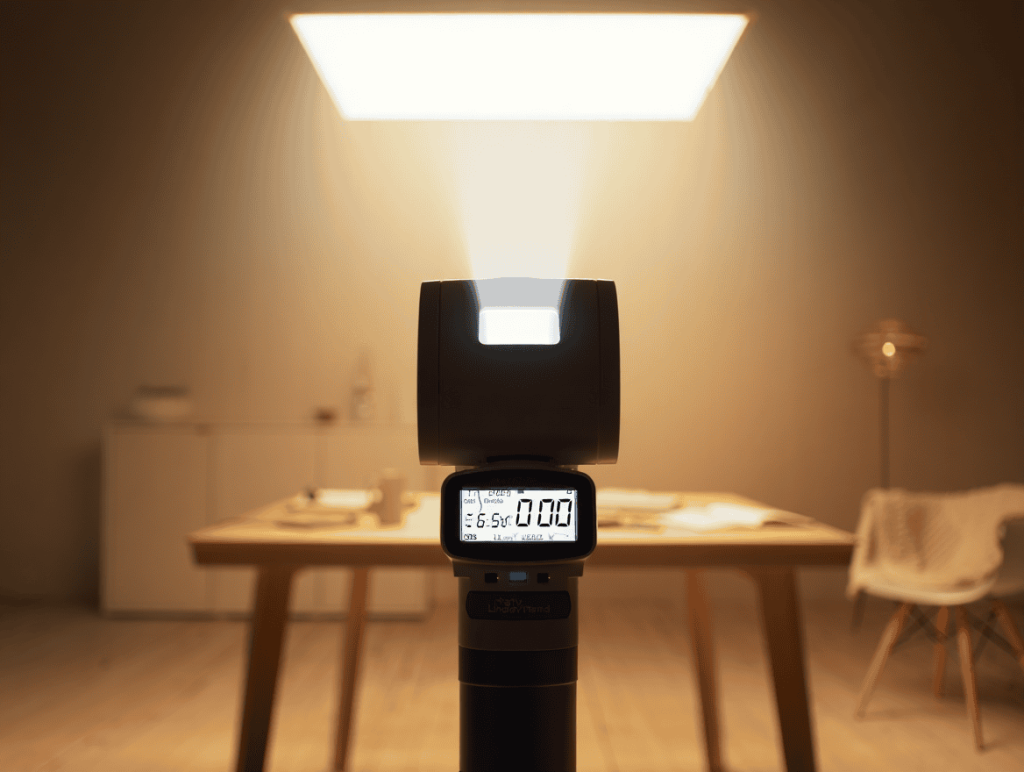
Frequently Asked Questions:
- Warehouses & storage areas: 20–30 fc
- Manufacturing & assembly floors: 50–100 fc
- Office workspaces: 30–50 fc
- Retail showrooms: 50–100 fc
- Parking lots & garages: 2–5 fc
- Hockey arenas & sports facilities: 50–100 fc (broadcast-ready: 150+ fc)
- Hospitals & senior care: 50–75 fc
If you’ve ever hired an electrician, designed a retail space, or reviewed a lighting specification sheet, you’ve likely encountered a term that sounds oddly old-fashioned: the foot candle. While Canada officially adopted the metric system in the 1970s and uses lux as its standard unit of illuminance, foot candles still appear regularly in American product datasheets, commercial lighting specs, and building codes used by cross-border contractors. Whether you’re renovating your home in Calgary, opening a restaurant in Toronto, or managing a warehouse in Vancouver, understanding foot-candles — and how to convert them to lux — can save you time, money, and costly lighting mistakes.
What Exactly Is a Foot Candle?
A foot-candle (fc) is a unit of illuminance. It measures how much light actually falls on a surface — not how much a bulb produces, but how much arrives and illuminates a given area.
| Simple definition: One foot-candle equals the amount of light that one candle produces on a surface that is exactly one foot away from it. |
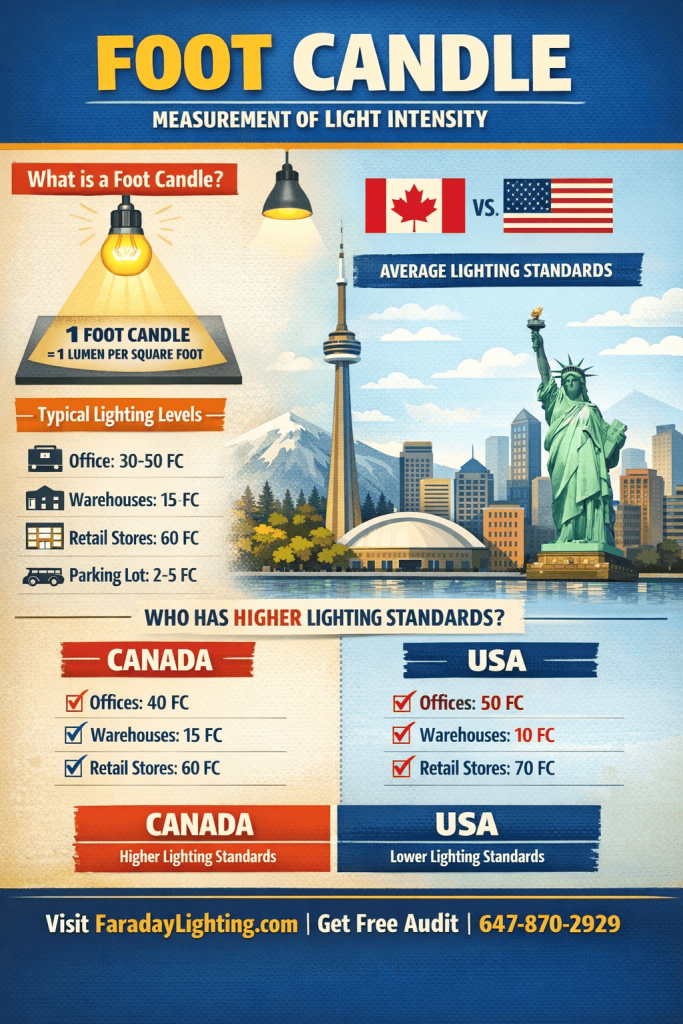
More precisely, one foot-candle equals one lumen of light spread over one square foot of surface area. This is a practical measurement: it tells you how bright a space actually is from the perspective of the person (or camera, or plant) inside it.
The term dates back to the early days of photometry, when candles were the universal light source for comparison. Despite its age, the unit remains in common use across the United States, and therefore shows up frequently in North American commercial and industrial contexts.
Lighting & Electrical Guide For Canadian Homeowners, Contractors & Business Owners
Foot-Candles vs. Lux: The Canadian Conversion
Canada uses lux (lx) as part of the International System of Units (SI). Lux measures the same thing as foot-candles — illuminance — but uses the metric square metre instead of a square foot.
The Conversion Formula
| To Convert | Multiply By | Result |
| Foot-Candles → Lux | 10.764 | Lux (lx) |
| Lux → Foot-Candles | 0.0929 | Foot-Candles (fc) |
For quick mental math, most lighting professionals round to 10x: multiply foot-candles by 10 to get an approximate lux value. So 50 fc ≈ 500 lux. For precise work — especially in engineering reports or when specifying photometric data — use the exact factor of 10.764.
Quick Conversion Examples
| Foot-Candles (fc) | Lux (lx) | Typical Setting |
| 1 fc | 10.8 lx | Moonlit outdoor scene |
| 10 fc | 107.6 lx | Hallway or stairwell |
| 30 fc | 322.9 lx | General office work |
| 50 fc | 538.2 lx | Retail display, kitchen task |
| 100 fc | 1,076.4 lx | Surgical suite, TV studio |
| 500 fc | 5,382 lx | Bright outdoor sunlight |
Foot Candles vs. Other Lighting Terms
Lighting terminology can be confusing because several related — but distinct — units are often used interchangeably in casual conversation. Here’s how they relate:
| Term | Unit | Measures | Where It Applies |
| Luminous Flux | Lumen (lm) | Total light output | Light bulb specs |
| Illuminance | Foot-Candle (fc) or Lux (lx) | Light hitting a surface | Room & task lighting |
| Luminance | Candela/m² (cd/m²) | Light coming toward your eye | Display screens, signs |
| Luminous Intensity | Candela (cd) | Light in a specific direction | Spotlights, beams |
For most practical lighting decisions — choosing bulbs, designing a workspace, or meeting building code — illuminance (foot-candles or lux) is the most relevant measure.
How to Measure Foot Candles
Measuring illuminance in your space is straightforward with the right tool. Here are your main options:
-
Dedicated Light Meter (Most Accurate)
A digital light meter, also called a lux meter or illuminance meter, is the professional standard. Most meters sold in Canada display readings in lux by default, but many also include a foot-candle mode. Prices range from around $30 CAD for basic models to several hundred dollars for precision instruments used in photography, horticulture, or safety compliance.
-
Smartphone Apps (Convenient, Less Precise)
Apps like Lux Light Meter Pro or Light Meter use your phone’s ambient light sensor to estimate illuminance. These can be useful for quick checks but are not reliable enough for engineering or compliance purposes. Readings can vary by 20–40% depending on the phone model.
-
Photometric Software (Design Phase)
When designing a new lighting system, electrical engineers and lighting designers use photometric software such as AGi32 or DIALux to simulate foot-candle levels across a space before any fixtures are installed. This is standard practice for commercial, industrial, and institutional projects across Canada.
Tips for Accurate Measurement
- Hold the sensor parallel to the surface you are measuring (horizontal for desks, vertical for walls).
- Take readings at the working plane height — typically 76 cm (30 inches) for desks, 90 cm (36 inches) for kitchen counters.
- Measure at multiple points across the space and average the results for a representative reading.
- Allow LED fixtures to warm up for 15–20 minutes before measuring for stable output.
- Account for the age of the fixture: older lamps and dirty lenses can reduce actual foot-candles by 20–30% from their rated output.
Recommended Foot-Candle Levels for Canadian Spaces
The Illuminating Engineering Society (IES) publishes widely referenced guidelines for lighting levels across building types. While Canadian standards (such as those from the National Building Code and CSA Group) specify requirements in lux, the IES values below are commonly referenced in North American practice. Lux equivalents are included for convenience.
|
Space / Application |
Recommended (fc) | In Lux (approx.) |
Notes |
| Outdoor parking lot | 1–5 fc | 11–54 lx | Safety & security minimum |
| Residential hallway | 5–10 fc | 54–108 lx | Low-traffic, accent lighting |
| Living room (general) | 10–20 fc | 108–215 lx | Ambient, dimmable |
| Kitchen (general) | 30–50 fc | 323–538 lx | Task zones need more |
| Kitchen counter (task) | 50–100 fc | 538–1,076 lx | Under-cabinet lighting ideal |
| Home office / desk | 30–50 fc | 323–538 lx | Reduce screen glare |
| Retail display | 50–100 fc | 538–1,076 lx | Higher for feature displays |
| Grocery store | 30–50 fc | 323–538 lx | Produce areas often higher |
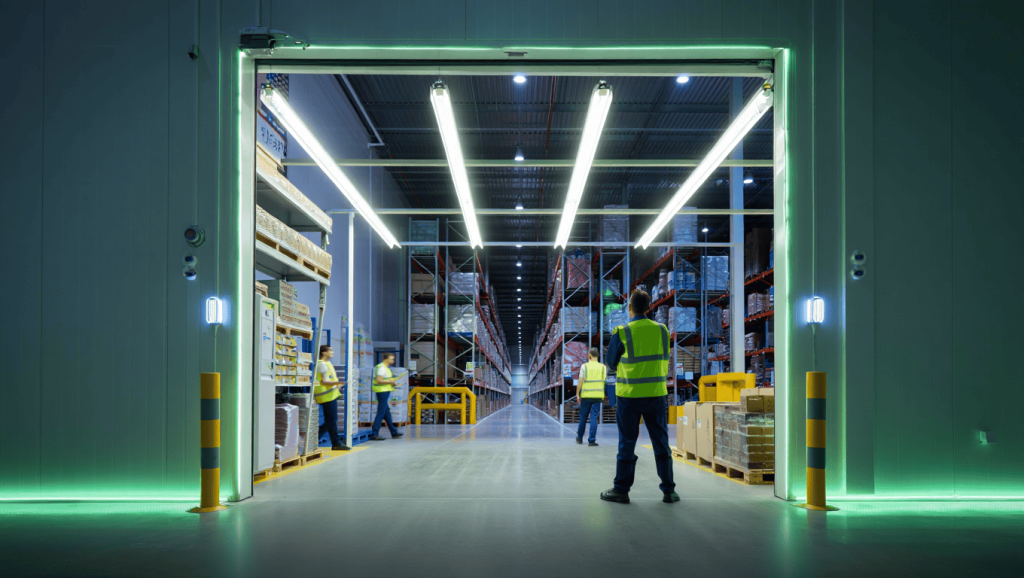
| Warehouse (general) | 20–30 fc | 215–323 lx | Higher near pick stations |
| Manufacturing floor | 50–100 fc | 538–1,076 lx | Depends on task detail |
| School classroom | 30–50 fc | 323–538 lx | Uniform distribution key |
| Hospital exam room | 50–100 fc | 538–1,076 lx | Surgical: up to 10,000 fc |
| Photography studio | 100–200 fc | 1,076–2,153 lx | Varies by setup |
| Greenhouse (seedlings) | 20–40 fc | 215–430 lx | Supplemental grow lighting |
| Note: The National Building Code of Canada and provincial codes reference CSA and IES standards. Always verify with your local Authority Having Jurisdiction (AHJ) and a licensed electrical contractor near me for code compliance. |
Does Foot-Candles Still Matter in Canada?
Given that Canada uses metric, you might wonder why foot-candles come up at all. There are several practical reasons:
-
American Product Specifications
The vast majority of commercial lighting fixtures sold in Canada are manufactured in or specified for the American market. LED troffer datasheets, high-bay fixture specs, and luminaire photometric files (IES files) routinely report output in foot-candles. Canadian buyers, specifiers, and contractors encounter these figures daily.
-
Cross-Border Consulting
Many Canadian architecture and engineering firms work on both sides of the border or collaborate with American counterparts. Fluency in both foot-candles and lux is a basic professional skill in the lighting industry.
-
Legacy Equipment & Documentation
Older buildings and facilities — factories, warehouses, institutional buildings — may have original lighting documentation in foot-candles. Renovation projects require contractors to understand and match historic specifications.
-
Photography & Videography
The North American film and photography industry overwhelmingly uses foot-candles. If you’re setting up a podcast studio, YouTube channel, or professional photography space in Canada, you’ll be working in foot-candles when reading equipment specs and tutorials.
Foot-Candles in Canadian Workplace Safety
Workplace lighting in Canada is governed by provincial occupational health and safety legislation. Each province sets its own minimum requirements, but many reference or align with the IES Handbook. Here’s a general overview:
| Province / Territory | Primary Regulation | Lighting Units Used |
| Ontario | O. Reg. 851 (Industrial) / O. Reg. 67/93 (Construction) | Lux |
| British Columbia | WorkSafeBC OHS Regulation | Lux |
| Alberta | OHS Code (Part 5, Lighting) | Lux |
| Quebec | LSST / Regulation on OHS | Lux |
| All Provinces | National Fire Code of Canada (exit lighting) | Lux (10 lx minimum at floor) |
While Canadian regulations use lux, American OSHA standards — which many Canadian multinationals and cross-border firms reference for internal policies — specify foot-candles. Knowing both systems ensures you can navigate either framework.
Common Foot-Candle Mistakes to Avoid
- Confusing lumens with foot-candles: Lumens measure total output from a source; foot-candles measure what arrives at a surface. A 1,000-lumen bulb does not deliver 1,000 foot-candles to your desk.
- Ignoring the inverse square law: Light intensity drops with the square of the distance. Doubling the distance from a fixture to a surface reduces illuminance to one-quarter, not one-half.
- Measuring at the wrong height: Always measure at the working plane, not at floor level or ceiling height.
- Using a single measurement point: One reading in the centre of a room is not representative. Take a grid of readings and calculate the average and uniformity ratio.
- Forgetting maintenance factors: Lamps dim over time and fixtures collect dust. Plan for a Light Loss Factor (LLF) of 0.7–0.8 when designing new installations.
Final Thought
Foot-candles may be an imperial-era measurement, but they remain a practical reality for anyone involved in lighting in Canada. Whether you’re renovating a home, specifying a commercial fit-out, or simply trying to understand why your workspace feels dim, knowing how to read, convert, and apply foot-candle values is a genuinely useful skill.
The key takeaways are simple: multiply foot-candles by 10.764 to get lux; use a calibrated light meter for accurate readings; and match your illuminance levels to the task and space. From a Calgary warehouse to a Toronto café, good lighting starts with knowing your numbers.
Quick Reference: 1 foot-candle = 10.764 lux | 1 lux = 0.0929 foot-candlesFor fast estimates: fc × 10 ≈ lux
Smarter Light. Bigger Savings. Get Free Audit.
15+ Years | 500+ Projects | Millions Saved | 10+ Industries
faradaylighting.com • 647-870-2929 • info@faradaylighting.ca