


Metal Halide to LED Retrofit Conversion Kit – Save Up to 75% Energy

What Is a Foot Candle
March 24, 2026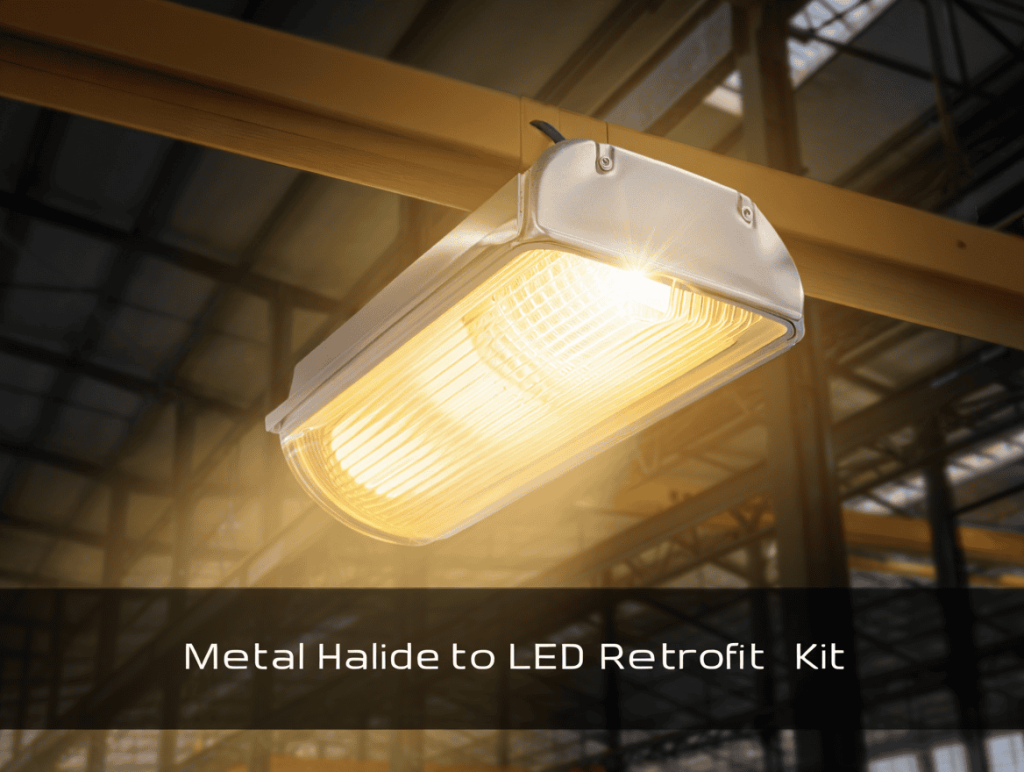
If you manage a warehouse in Ontario, a parking garage in Calgary, or a big-box retail space anywhere from Halifax to Victoria, there’s a good chance your ceiling is still lit by metal halide (MH) lamps. They’ve been the workhorse of commercial and industrial lighting for decades — and for good reason. But in 2024, keeping those fixtures running is quietly costing you thousands of dollars every year. The good news? You don’t need to gut your entire lighting system. A metal halide to LED retrofit conversion kit lets you upgrade your existing fixtures to energy-efficient LED technology — without the cost or disruption of a full replacement. And in Canada, where energy costs are rising, winters are brutal, and sustainability reporting is becoming a boardroom priority, the business case has never been clearer.
What Exactly Is a Metal Halide to LED Retrofit Conversion Kit?
Think of it as a transplant, not a replacement. A retrofit conversion kit swaps out the internal components of your existing metal halide fixture — the lamp, ballast, and sometimes the reflector — and replaces them with a modern LED driver and light engine. Your existing housing, mounting hardware, and wiring largely stay in place.
The result: you get the light output and coverage you already planned your space around, but with a fraction of the energy draw and virtually none of the maintenance headaches.
Retrofit kits are available for the most common MH fixture types used across Canada:
- High bay fixtures (warehouses, manufacturing plants, gymnasiums)
- Flood lights and area lights (parking lots, sports fields, building exteriors)
- Shoebox and cobra head fixtures (roadways, municipal lots)
- Wall packs (loading docks, building perimeters)
The Real Cost of Keeping Your Metal Halide Fixtures
Let’s talk numbers — because this is where the conversation gets interesting for any Canadian facility manager or business owner. A standard 400-watt metal halide lamp draws closer to 455–480 watts when you factor in ballast losses. Replace that with a quality LED retrofit kit and you’re typically looking at 120–150 watts for equivalent or better light output. That’s a 65–75% reduction in energy consumption per fixture.
Now multiply that across a facility with 80 high bays running 16 hours a day, 250 days a year. At Ontario’s mid-tier commercial hydro rate of roughly $0.12–$0.16/kWh (rates vary by province and utility), the annual savings can easily reach $15,000–$25,000 for a mid-sized warehouse — before you factor in rebates.
And then there’s maintenance. Metal halide lamps have a rated life of around 10,000–20,000 hours, and their light output degrades significantly in the back half of their lifespan. LED modules in quality retrofit kits are rated for 50,000–100,000 hours, with minimal lumen depreciation over that time. Fewer lamp changes. Fewer lift rentals. Less labour. Fewer emergency callouts when a lamp fails mid-shift.
Why This Matters Especially in Canada
Canadian conditions put a unique set of demands on lighting infrastructure that makes LED retrofits even more compelling here than in warmer markets.
Cold weather performance. Metal halide lamps are notoriously finicky in cold temperatures. In an unheated loading dock in Edmonton in January, MH lamps can take 5–10 minutes to reach full brightness after startup — and if power flickers, they require a 5–15 minute restrike period before relighting. Modern LED retrofit modules operate at full output instantly, even at –40°C. That’s not just convenient — in a safety context, it matters.
Longer heating seasons mean more indoor operating hours. Canadian facilities often run their lighting systems for more hours per day than equivalent operations in the U.S. Sun Belt. More hours means your payback period on a retrofit investment shortens faster.
Provincial energy rebate programs. This is one of the most underutilized financial tools available to Canadian businesses. Utilities and provincial programs across the country offer significant incentives for commercial and industrial LED upgrades:
- Ontario (saveONenergy): Prescriptive rebates for LED retrofits in commercial and industrial settings
- BC Hydro (Power Smart): Retrofit incentives for eligible businesses
- Hydro-Québec: Commercial efficiency programs with per-fixture rebates
- Efficiency Nova Scotia, Manitoba Hydro, ATCO, FortisAlberta: Each province has its own program with varying rebate structures
In many cases, rebates can offset 20–40% of project costs, dramatically shortening the payback period — sometimes to under 2 years. Canada’s carbon pricing trajectory. With federal carbon pricing continuing to rise, energy-intensive facilities face increasing pressure to reduce consumption. An LED retrofit directly reduces your facility’s electricity draw, which lowers both your hydro bill and your carbon footprint. For companies subject to ESG reporting or sustainability commitments to customers and investors, that’s a tangible, documentable win.
Retrofit Kit vs. Full Fixture Replacement: Which Makes Sense?
This is the question every facility manager should ask — and the honest answer is: it depends on your fixture condition and your budget.
Retrofit kits make the most sense when:
- Your existing fixture housings are structurally sound and in good condition
- You want to minimize installation time and disruption
- Your fixtures are ceiling-mounted in a way that makes replacement labour-intensive
- You want to maximize ROI by eliminating the cost of new housings
Full fixture replacement may be the better call when:
- Your existing fixtures are corroded, damaged, or non-standard
- You’re doing a broader facility renovation anyway
- You want to take advantage of newer optical designs for improved uniformity
- Your current fixture layout doesn’t match your operational needs
For most retrofit projects on standard commercial and industrial high bays and area lights, a quality conversion kit hits the sweet spot of performance, cost, and installation speed.
What to Look for in a Quality LED Retrofit Conversion Kit?
Not all retrofit kits are created equal. Here’s what separates a sound investment from a purchasing decision you’ll regret in three years:
Photometric certification
Look for kits tested and certified to IES (Illuminating Engineering Society) standards, with documented lumen output, efficacy (lumens per watt), and beam angle data. This lets you — or your lighting designer — verify that your space will meet minimum foot candle requirements.
CSA or ETL certification
In Canada, this is non-negotiable. The kit must be certified for the Canadian market by a recognized testing body. Uncertified product can void your insurance and create liability exposure.
Colour rendering index (CRI) ≥ 80
For most commercial and industrial applications, a CRI of 80 or above ensures that materials, products, and safety signage appear as intended under the light. Warehouses picking products by colour and retail spaces displaying merchandise should prioritize this.
Colour temperature appropriate for the application. 5000K (cool white/daylight) is common for warehouses and industrial spaces where visual acuity matters. 4000K is popular for retail and office-adjacent spaces. Warmer tones (3000K) suit hospitality settings.
Warranty
Quality LED retrofit kits should carry at least a 5-year warranty, with leading manufacturers offering 10 years. A manufacturer standing behind their product for a decade is a manufacturer confident in their driver and LED module quality.
DLC (DesignLights Consortium) listing
Many Canadian utility rebate programs require that the retrofit kit be listed on the DLC Qualified Products List. Confirm eligibility before purchasing if rebates are part of your financial model.
A Typical Project: What the Process Looks Like
Most metal halide to LED retrofit projects follow a straightforward sequence:
- Comprehensive Lighting audit – A lighting professional or your lighting supplier assesses your current fixtures, measures existing light levels, and identifies the correct retrofit kit for each fixture type. Get a Free Lighting Audit From Faraday.
- Photometric modelling – Software simulates the post-retrofit light levels to confirm you’ll meet the required foot-candles for your space and any applicable codes (OHS, building codes, etc.).
- Rebate pre-approval – If applicable, your contractor or energy advisor submits your project to the utility for pre-approval before installation begins. This step is critical — most rebate programs require this.
- Installation – A licensed electrician performs the retrofit. Depending on kit type, a fixture conversion typically takes 15–45 minutes per unit, meaning a facility with 60 high bays can often be fully converted in a single day or two.
- Commissioning and documentation – Post-installation measurements confirm light levels, and paperwork is filed for rebate claims.
The Bottom Line
Metal halide technology served Canadian industry well for a long time. But the economics — and the environmental arithmetic — have shifted decisively. Faraday LED retrofit conversion kits offer a pragmatic, cost-effective path to dramatically lower energy bills, slashed maintenance costs, and measurably better light quality, without the capital outlay of a full system replacement.
With provincial rebates reducing upfront costs and energy savings compounding year over year, most Canadian commercial and industrial facilities are looking at payback periods of 18 months to 3 years — and then decades of savings beyond that. If your building is still lit by metal halide, the question isn’t really whether to retrofit. It’s how soon you can afford not to.
Ready to find out what a metal halide to LED retrofit could save your facility? Book Faraday lighting audit and a conversation with your provincial utility about available rebates. The numbers may surprise you.