Metal Halide to LED Retrofit Conversion Kit – Save Up to 75% Energy
March 25, 2026
How to Choose a Ceiling Light
April 15, 2026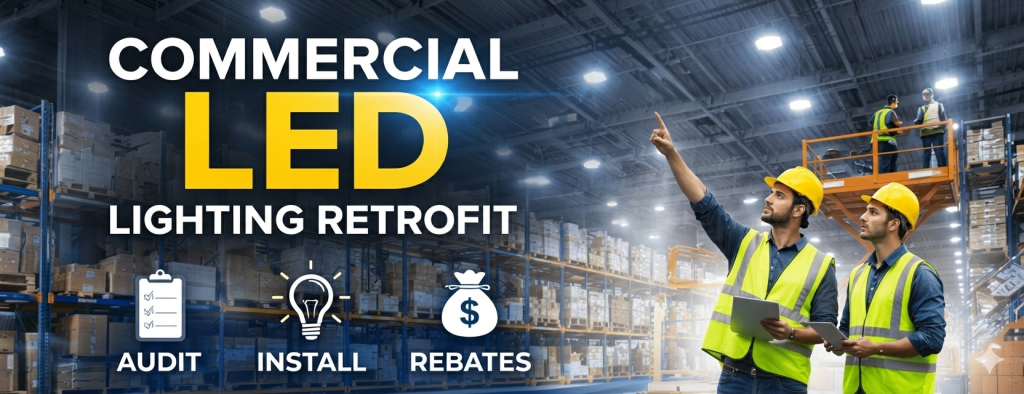
For facility managers, property owners, and CFOs across Ontario, the conversation about upgrading to LED lighting almost always stalls at the same point: how long until we get our money back? It's the right question. And unlike many capital investments, LED lighting retrofits give you a precise, calculable answer — not a guess. This guide walks you through the exact ROI formula used by Faraday Lighting's engineering team, the Ontario-specific variables that determine your payback period, how government rebates and federal tax treatment accelerate your return, and what real-world results look like from completed projects in this province.
Commercial LED Lighting Retrofit in Ontario (2026 Guide)
If you manage a commercial or industrial facility in Ontario and your lighting is more than five years old, you almost certainly have a payback period under three years. Here is how to verify that — before you call anyone.
1. Why ROI Calculation Comes Before the Rebate Application
Many facility managers approach LED retrofits backwards: they ask about rebates first, then think about whether the project makes financial sense. The more effective sequence is the reverse.
Ontario's Save on Energy Custom Incentive program — administered by IESO — requires applicants to submit a pre-approval application that includes your baseline energy consumption, the proposed new system's projected consumption, and the expected annual energy reduction in kWh. In other words, IESO makes you do the ROI math anyway. Doing it first means you arrive at the rebate application with verified numbers, a stronger submission, and no surprises about project cost.
It also gives you the single most useful document for internal approval: a one-page financial case that shows payback period in months, not years, with and without the rebate applied.
2. The ROI Formula, Explained Simply
There are two numbers that matter most: annual energy savings and net project cost. Everything else — maintenance savings, rebates, tax treatment — either increases the first number or reduces the second.
The core payback formula
Simple Payback Period Formula: |
Breaking each component down:
- Total project cost — fixtures, installation labour, and disposal of old equipment.
- Rebates — Ontario Save on Energy Instant Discounts (no paperwork, deducted at point of sale by an Approved Retailer like Faraday) or Custom Incentive amounts confirmed at pre-approval.
- Tax credits — federal Accelerated Investment Incentive (AII) under CRA Class 8, discussed in Section 5.
- Annual energy savings — the difference in electricity consumption between your old and new system, multiplied by your blended rate per kWh.
- Annual maintenance savings — reduced lamp replacements, eliminated ballast failures, and lower labour. LED systems rated at 50,000+ hours typically cut maintenance costs by 50–70% versus fluorescent or HID.
3. Ontario-Specific Variables to Plug In
Generic LED ROI calculators often use national averages that understate the Ontario opportunity. Here are the province-specific inputs that change the math significantly.
Ontario commercial electricity rates (2026)
Commercial electricity in Ontario is billed in layers: the commodity rate (set by IESO), the delivery charge (set by your local distribution company), and regulatory and debt retirement charges. The all-in blended rate for most small-to-medium commercial accounts typically falls between $0.14 and $0.19 per kWh when all components are combined.
Large industrial customers on Wholesale Market Service may pay differently — check your most recent utility bill for your actual blended rate, or use $0.16/kWh as a conservative Ontario-wide benchmark for this calculation.
Operating hours by facility type
The higher your annual operating hours, the faster your payback. Use the following as baselines:
| Facility type | Typical annual hours | Payback impact |
|---|---|---|
| Warehouse / distribution centre | 5,500–6,500 hrs/yr | Fastest payback |
| Manufacturing plant | 5,000–8,760 hrs/yr | Fastest payback |
| Commercial office building | 2,500–3,500 hrs/yr | Moderate payback |
| Retail space | 4,000–5,000 hrs/yr | Moderate payback |
| Hockey arena / sports facility | 4,500–6,000 hrs/yr | Moderate to fast |
| Parking garage (exterior) | 4,000–5,000 hrs/yr | Moderate payback |
Wattage reduction by fixture type
The energy savings per fixture is simply the difference between old and new wattage, multiplied by operating hours. Here are typical reductions Faraday achieves:
| Replaced fixture | Old wattage | LED replacement | New wattage | Reduction |
|---|---|---|---|---|
| T8 fluorescent (4 ft) | 32 W | LED T8 tube | 18 W | 44% |
| Metal halide high bay (400W) | 400 W | LED UFO high bay | 150 W | 62% |
| HPS parking lot | 250 W | LED shoebox | 100 W | 60% |
| HID wall pack (250W) | 250 W | LED wall pack | 80 W | 68% |
| PAR38 halogen | 90 W | LED PAR | 13 W | 86% |
| T12 fluorescent | 40 W | LED T8 tube | 18 W | 55% |
4. A Worked Example: Mid-Sized Ontario Warehouse
To make the formula concrete, here is a representative example modelled on the type of project Faraday Lighting regularly executes in the GTA and surrounding industrial corridors.
- Facility: 50,000 sq ft distribution warehouse, Mississauga, Ontario
- Existing lighting: 120 × 400W metal halide high bay fixtures
- Proposed: 120 × 150W LED UFO high bay fixtures (DLC Premium listed)
- Operating hours: 6,000 hrs/yr (single shift plus security lighting)
- Blended electricity rate: $0.165/kWh
| Parameter | Calculation | Result |
|---|---|---|
| Old annual consumption | 120 fixtures × 0.400 kW × 6,000 hrs | 288,000 kWh/yr |
| New annual consumption | 120 fixtures × 0.150 kW × 6,000 hrs | 108,000 kWh/yr |
| Annual kWh saved | 288,000 − 108,000 | 180,000 kWh/yr |
| Annual energy savings ($) | 180,000 kWh × $0.165 | $29,700/yr |
| Annual maintenance savings | Estimated lamp/ballast labour reduction | $4,800/yr |
| Total annual savings | $29,700 + $4,800 | $34,500/yr |
Project cost and net investment
| Cost component | Amount (CAD) |
|---|---|
| Fixture supply (120 × LED high bay) | $36,000 |
| Installation labour (ESA-compliant) | $14,400 |
| Gross project cost | $50,400 |
| Save on Energy Instant Discount (est.) | − $9,000 |
| Net project cost after rebate | $41,400 |
Payback calculation: Payback = $41,400 ÷ $34,500/yr = 1.2 years (approximately 14 months) |
At 14 months payback, this facility earns back the full net investment before the second winter — then generates $34,500 in free cash flow every year after that, for the expected 15–20 year life of the LED fixtures.
5. Real Ontario Results: Two Faraday Case Studies
Case Study 1: Toronto office building — 54% energy reduction, 20-month payback
211 Consumers Road, a 40+ year-old Toronto office building, retrofitted its T8 fluorescent interior lighting, PAR38 halogen common area lamps, and HID exterior fixtures to full LED.
Total energy consumption dropped from 313,317 kWh/yr to 144,891 kWh/yr — a 54% reduction representing a 168,426 kWh annual saving. Annual electricity savings exceeded $20,000. Based on the capital invested for common area retrofits, the ROI was approximately 60% with a 20-month payback period on energy savings alone.
The Toronto Hydro rebate under the saveONenergy program covered approximately 15% of total project cost, and the elimination of monthly ballast and lamp replacements delivered an additional $1,700 per month in operational savings — projected to reach $100,000 over the life of the installation.
Case Study 2: Briton House Retirement Centre — 72% reduction, 13-month payback
This seniors facility replaced T12 and T8 fluorescents, incandescent stairwell lamps, halogen PAR38 and MR16 fixtures, metal halide parking garage fixtures, and incandescent chandelier bulbs throughout the building.
The result was a 72% reduction in lighting energy consumption, saving $31,360 per year. Over five years, total savings reached $196,905 including $12,380 in reduced maintenance costs. The OPA rebate covered 30% of the project cost, and the overall payback period was just 13 months, with a 96% return on investment.
Note: Both case studies are available in full on the Faraday Lighting website and include fixture-by-fixture energy comparison tables.
6. How Rebates Affect Your ROI Calculation
Ontario's Save on Energy program offers two primary streams relevant to commercial LED retrofits:
Instant Discounts (point-of-sale rebates)
For standard LED products — T8 tubes, troffers, flat panels, high bays, wall packs — qualifying fixtures purchased through an approved participating retailer like Faraday Lighting receive an instant discount applied at purchase. No application, no waiting, no paperwork. These discounts are deducted from your project cost immediately and directly reduce your net investment number in the payback formula.
Custom Incentive Program
For larger or more complex projects, the Custom Incentive stream offers calculated incentives based on the verified kWh reduction achieved by the project. These require a pre-approval application before work begins. The incentive is paid after the project is complete and verified. For projects over 100 fixtures or with complex control systems, this stream often produces a larger dollar rebate than the Instant Discount equivalent.
Important: rebates under Save on Energy are generally considered income for tax purposes in Canada. Consult your accountant on how to treat the rebate in your year of claim.
7. Federal Tax Treatment: How the CRA Accelerates Payback
LED lighting equipment installed in a commercial facility is classified under CRA Class 8 (Other Property), which carries a 20% declining balance Capital Cost Allowance (CCA) rate. However, two federal provisions meaningfully accelerate cost recovery:
Accelerated Investment Incentive (AII)
For eligible depreciable property acquired after November 20, 2018 and available for use before 2028, the AII allows businesses to claim 1.5 times the normal first-year CCA deduction. In practical terms, this means a larger income tax deduction in the year the LED fixtures are placed in service, improving after-tax cash flow in year one, which further tightens the effective payback period.
Clean Technology Investment Tax Credit (CT-ITC)
For LED projects that incorporate qualifying clean energy equipment — including certain control systems and sensors, the federal CT-ITC may provide a refundable 30% tax credit on the capital cost of eligible components. Eligibility is specific to the type of equipment and the corporate structure of the applicant. This is a significant lever for projects that qualify, as it directly reduces tax payable (or generates a refund) rather than simply providing a deduction.
| Tax guidance note: CRA tax treatment depends on your corporate structure, fiscal year, and asset mix. The information above is general in nature. Always confirm treatment and eligibility with a qualified accountant or tax advisor before filing. |
8. Common Mistakes That Inflate Your Payback Period
Facility managers who do this calculation themselves sometimes arrive at a longer payback than the project actually delivers. Here are the most common reasons:
- Using the commodity rate only: Your blended rate includes delivery, regulatory, and global adjustment charges. Using only the IESO commodity rate (which appears on your bill as a separate line) understates savings by 40–60%.
- Forgetting maintenance savings: Lamp and ballast replacements in a typical fluorescent building cost $3,000–$8,000 per year in parts and labour. LED eliminates most of this. Leaving it out of the formula produces a payback that is 15–25% longer than reality.
- Not applying for rebates before installation: The Save on Energy Custom Incentive requires pre-approval. Projects that proceed without applying first are ineligible for the Custom Incentive stream, which is often the larger rebate for industrial facilities.
- Using incorrect operating hours: Facilities with 24/7 security lighting often undercount hours by not including overnight low-level operation. A more accurate hour count produces a more accurate (and usually shorter) payback.
- Using list price instead of net project cost: Your payback calculation should use the cost after Instant Discounts, which are deducted at purchase if you buy through an approved retailer. Using gross cost before discounts overstates payback by the rebate amount.
Ready to calculate your facility's actual payback period?Faraday Lighting provides free facility audits for commercial and industrial properties across Ontario — including a full ROI analysis, rebate identification, and photometric design. No obligation. → Book Your Free Audit→ Call: 647-870-2929 | info@faradaylighting.ca |