LED Troffer: Retrofit Kit vs. Whole Fixture Replacement?
April 30, 2026
Why IoT Lighting Matters for Commercial, Residential, and Retail Spaces (2026 Guide)
May 8, 2026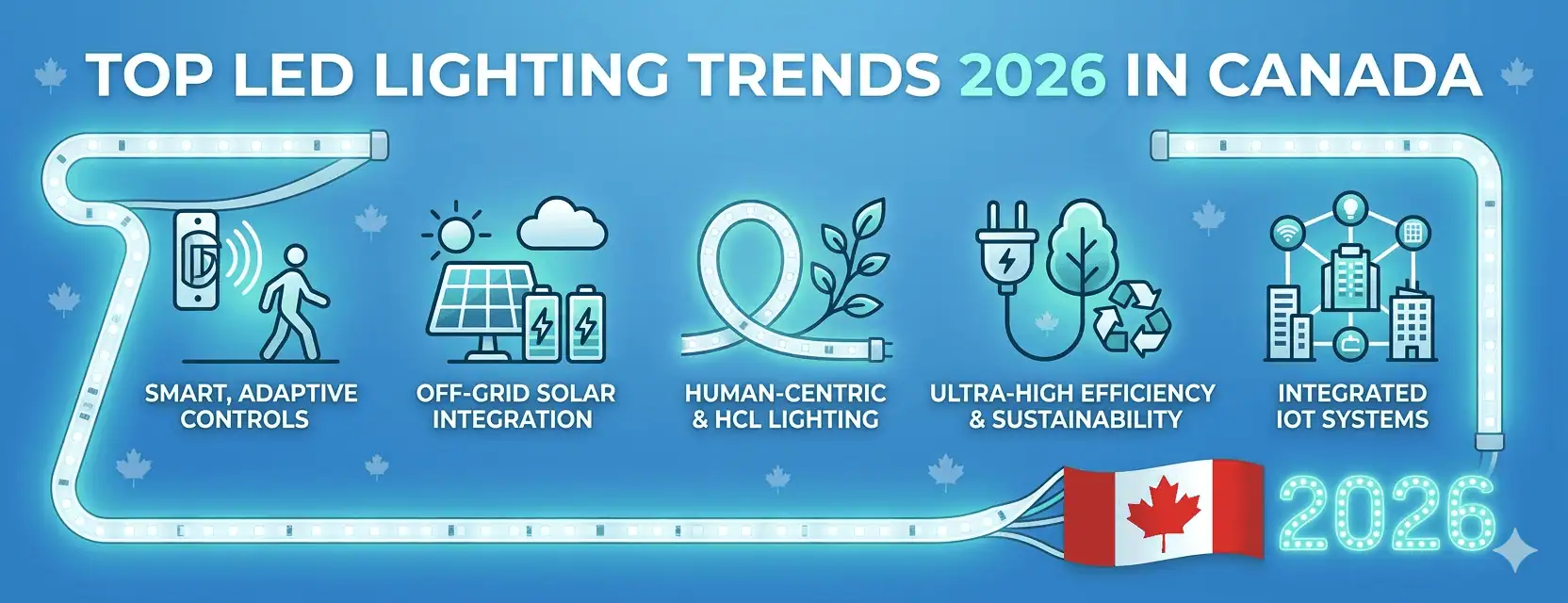
Another increase on your hydro bill. You are still using metal halides dated from 2009 in your warehouse. Dimming office fluorescents and blown-out loading dock wall packs are quietly siphoning money from your pocket. Ignoring led lighting trends 2026 traps you with outdated tech; you effectively subsidize inefficiency every time you flip a switch.
You should begin to wonder. By 2026, it is the businesses and property owners in Ontario who are ignoring lighting that are leaving the most money on the table. Not on the bottom line or productivity levels, but in the slow, steady rise of energy dollars that continue to accumulate monthly.
5 Top Lighting Trends 2026 Shaping Canadian Spaces
Here’s what’s actually shaping commercial and led lighting industry trends 2026 across Ontario this year, and what it means for your facility.
LED Lighting Trends 1: Smart Controls are No Longer Optional in Ontario
A few years ago, occupancy sensors and dimming controls were considered upgrades. In 2026, they’re the baseline expectation, especially if you’re applying for rebates through the Save on Energy program administered by the IESO.
The shift happened for a simple reason: Ontario’s electricity rates have made it impossible to ignore. Commercial facilities on time-of-use billing can pay anywhere from $0.11 to $0.18 per kWh, depending on the period.
A warehouse running 60 high bay fixtures at 400W each, eight hours a day, five days a week, is spending roughly $18,000–$26,000 annually on lighting electricity alone. Swap those for 150W LED high bays with occupancy sensors, and that figure drops to $7,000–$10,000.
That’s not a rounding error. That’s a hiring decision.
Faraday Lighting’s LED industrial high bay lights are built with optional motion sensor integration and 1-10V dimming out of the box. So you’re not paying for a second retrofit six months after the first one. Their UFO and linear series deliver up to 140+ lumens per watt, which means you get more light for less power, not just a different fixture.
If your current setup has no occupancy sensors, no dimming, and no photocell controls on your exterior fixtures, this is where the 2026 savings conversation starts.
LED Lighting Trends 2: The Retrofit Window Is Wide Open — But It Won’t Stay That Way
Ontario’s instant discount rebate program has made 2026 one of the most financially favourable years in recent memory for commercial LED retrofits. Eligible fixtures can qualify for immediate point-of-sale discounts, meaning you don’t have to front the full cost and wait months for a cheque. The paperwork reduction alone has removed the single biggest barrier that kept property managers stuck on fluorescent light.
But program budgets are finite. Facilities that acted in 2024 and 2025 secured better payback timelines than those who waited. Waiting further into 2026 risks reduced incentive amounts as program funds are allocated.
The honest reality: a properly scoped LED retrofit on a 30,000 sq. ft. Ontario office or light industrial building typically costs $15,000–$40,000 before rebates, and $8,000–$22,000 after. At current hydro rates, payback periods are running 18–30 months for most projects. That’s a return on investment most other capital improvements can’t touch.
Faraday’s Turnkey Lighting Solutions handle the entire process, audit, photometric design, product supply, ESA-compliant installation, and rebate application management, under one roof. For property managers juggling multiple contractors, this matters. You’re not coordinating three vendors; you’re making one call.
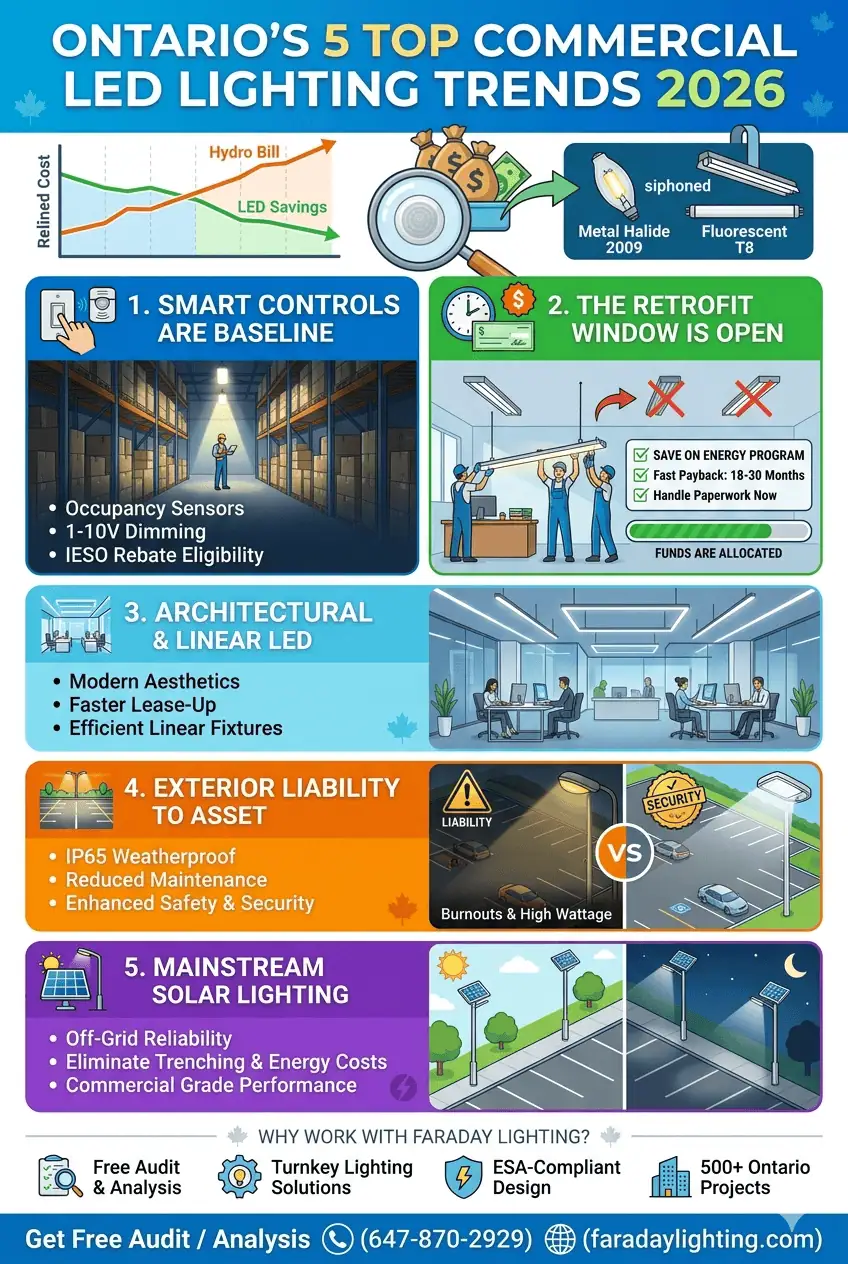
LED Lighting Trends 3: Architectural and Linear LED Is Redefining Commercial Interiors
Walk into any newly leased office in Toronto, Mississauga, or Oakville right now and you’ll notice something: the days of the buzzing 2×4 fluorescent troffer are over. Tenants expect better. And in a tight commercial real estate market where vacancy rates are climbing, landlords who invest in modern lighting are seeing faster lease-up and fewer concessions.
The trend is toward clean, continuous linear LED runs, flush or suspended that give spaces a modern, finished appearance without aggressive reconfiguration of the ceiling grid. These fixtures also happen to be dramatically more efficient than the fluorescents they replace.
Faraday’s LED Flat Panels and LED Strip Light & Wraparound Indoor Linear options are exactly what this trend calls for. The flat panels drop into existing ceiling grids with minimal disruption — no new housings, no structural work. The linear strips suit open-concept spaces where you want a continuous glow rather than individual fixture islands.
If you manage a multi-tenant office building or a retail strip in the GTA, upgrading the common areas and corridors to architectural LED is one of the fastest ways to improve tenant perception without a full renovation.
Trend 4: Exterior Lighting Is Becoming a Liability – and an Asset
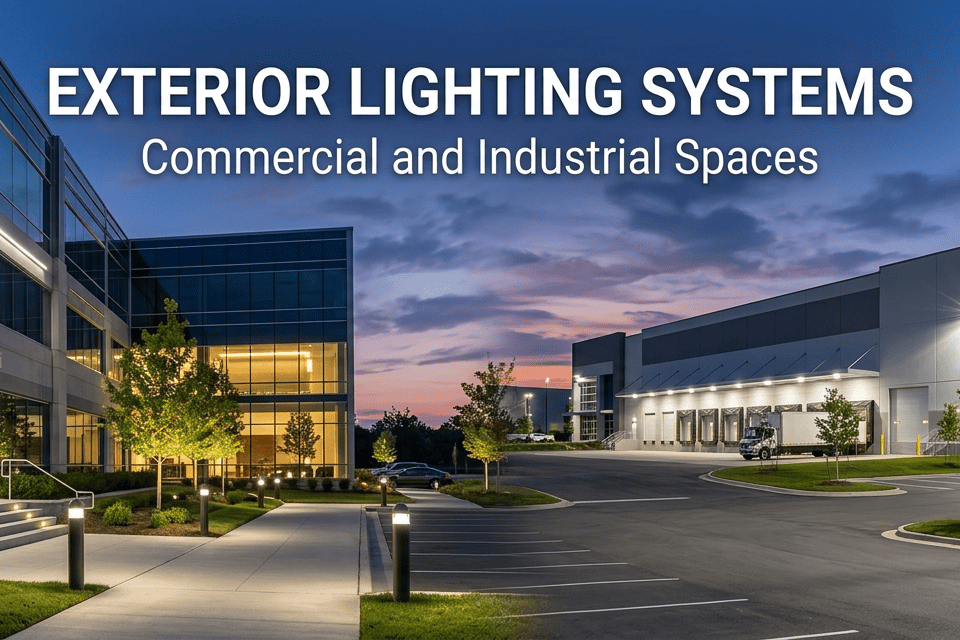
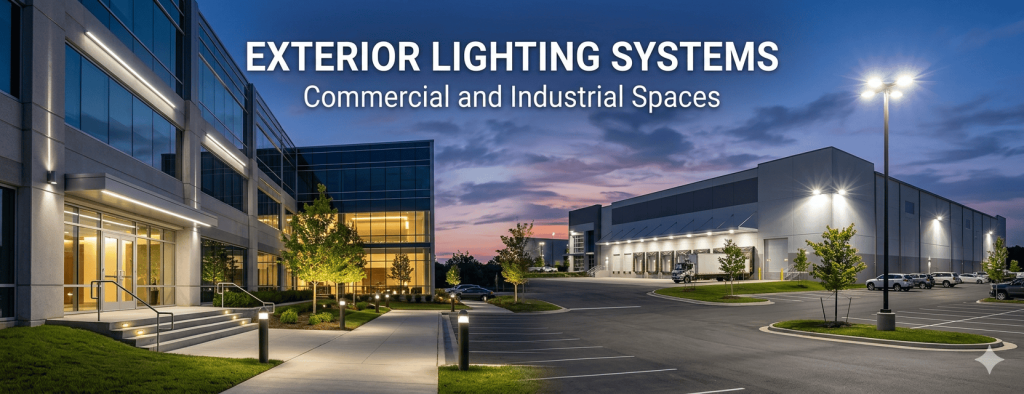
The parking lot is where a lot of Ontario property owners quietly bleed money. Aging metal halide and HPS fixtures burn out constantly, draw high wattage, and produce poor, uneven light. In colder months, which in Ontario means October through April, thermal cycling accelerates lamp failure. Some property managers are replacing bulbs two or three times per year in the same fixtures.
Faraday’s LED Wall Packs and Garage and Canopy Fixtures are rated IP65 for wet environments, carry DLC Premium certification for rebate eligibility, and are built to handle Ontario winters without the constant maintenance cycle. With output up to 135 lm/W and 50,000+ hour lifespans, you’re looking at a fixture that will likely outlast the next two lease cycles.
Apart from savings on maintenance costs, there is also a liability perspective that many property owners forget about. Bad lighting in exterior areas has been proven to be a contributing factor in slip-and-falls and crime incidents. Insurers and property appraisers are beginning to look at quality of lighting as a risk factor instead of merely a “nice-to-have” issue.
If you’re running your parking lot and building perimeter on HPS or metal halide then the cost of not retrofitting will now outweigh the cost of the retrofitting project.
Trend 5: Solar-Powered Exterior Lighting Is Moving Into Mainstream Commercial Use
Three years ago, commercial-grade solar lighting was considered niche, suitable for remote locations or municipalities, but not practical for most Ontario businesses. That’s changed.
Improvements in monocrystalline panel efficiency and lithium iron phosphate battery technology mean today’s commercial grade solar lighting can deliver reliable illumination for 3–5 nights of autonomy without any grid connection. For parking lots, pathways, and site perimeters where trenching to run conduit is expensive or disruptive, solar fixtures have become a genuinely practical option.
While solar LEDs cost 20–40% more upfront, eliminating energy and trenching expenses makes the total project cost comparable or lower. And for properties where adding electrical infrastructure isn’t feasible, solar isn’t just a trend. It’s the only viable path.
Why Good Intentions Stall
You’ve probably known your lighting needed attention for a year or two. The reason it hasn’t happened isn’t confusion about the technology. It’s the friction of getting started.
Who manages the rebate application, pulls the permits, or coordinates with your electrician? If the wrong fixture gets specified, does it qualify for the incentive? What happens if a tenant complains about disruption?
These are valid concerns, and they’re exactly why most lighting upgrades get pushed to next quarter indefinitely.
The answer isn’t to find three separate vendors and coordinate between them. It’s to work with a team that handles the entire scope under one contract, from the Lighting Audit and Analysis through to rebate submission.
Since 2011, Faraday Lighting has completed over 500 Ontario projects and holds Professional Engineers Ontario engineering design authorization. That’s not a sales line. It matters when you need ESA-compliant drawings and photometric documentation to satisfy your property insurer or municipality.
Why 2026 Specifically Matters
Ontario’s energy prices, rebate structures, and advanced LED technologies converge now into a fleeting, high-value opportunity. Hydro rates are projected to continue rising.
Rebate programs operate on fixed annual budgets that replenish, but not always at the same generosity level. And every month you run inefficient fixtures is a month of energy cost you don’t get back.
The businesses and property owners who upgraded in 2023 and 2024 are now three years into payback. Acting in 2026 secures excellent returns, but the window for accessible incentives and proven technology closes soon.
Who This Is NOT For
A full commercial retrofit rarely benefits small retail spaces under 2,000 sq. ft. with modest bills and updated fixtures. Postponing a lighting upgrade makes financial sense if you plan to renovate or demolish your building within three years. In both cases, a basic audit can confirm whether the math works, and a good one will tell you honestly if it doesn’t.
A Simple First Step
If you’ve read this far, you already know your facility lighting is worth looking at properly. The lowest-commitment way to find out exactly where you stand is a free lighting audit. No obligation, no sales pressure, just a clear picture of what your current setup is costing you and what a realistic improvement looks like.
Faraday Lighting offers free facility assessments covering existing fixtures, energy draw, rebate eligibility, and projected savings. It’s the same starting point they’ve used on every one of their Ontario projects, from small office retrofits to large industrial facilities.
To discover about latest LED lighting trends 2026, book your free audit, and find out what your lighting is actually costing you, and how much you can save.
Frequently Asked Questions
1) What lighting trends are Canadians actually going for in 2026?
Canadians are leaning toward lighting that feels warm, practical, and a little more personal. Think clean-lined fixtures, smart controls, and layered light that makes a room feel comfortable instead of overly bright or clinical.
2) Is smart lighting still worth it in 2026?
Yes, and it’s becoming more of a normal upgrade than a luxury. People like that smart lighting makes it easy to dim, schedule, and adjust light without changing the whole setup.
3) What color of light feels best in Canadian homes?
Warm white is still the favorite for living rooms, bedrooms, and other spaces where people want things to feel cozy. Cooler light is still useful for task areas like kitchens, offices, or laundry rooms, but most people want a softer look at home.
4) Are statement lights still in style, or is everything going minimalist?
Both are in style, which is why 2026 feels more interesting. A lot of Canadian spaces are mixing simple, understated fixtures with one bold piece that adds personality, like a sculptural pendant or a standout floor lamp.
5) What’s the easiest way to make older lighting feel more modern?
Start small with dimmers, better bulbs, or a fixture swap in one main room. Even one change, like replacing a dated ceiling light with something cleaner and more current, can make the whole space feel updated.
6) Why are layered lighting setups getting so much attention?
Because one overhead light usually isn’t enough anymore. People want a mix of ambient, task, and accent lighting so rooms feel more comfortable, flexible, and lived-in.
7) What lighting trends work best for Canadian weather and winters?
Warm, cozy lighting tends to matter more in Canada because long winters make indoor spaces feel even more important. Soft lighting, adjustable brightness, and bright task lights make homes feel inviting during dark winter months.