Type A vs Type B vs Type C LED T8 Lamps
April 28, 2026
5 LED Lighting Trends That Are Shaping Canadian Spaces
May 8, 2026LED Troffer: Retrofit Kit vs. Whole Fixture Replacement?
Choosing between an LED troffer retrofit kit and full fixture replacement depends on your budget, building condition, and long-term energy goals. You’ve got a drop ceiling full of 2×4 fluorescent troffers. They buzz, they flicker, two of them have been cycling on and off for three months. Every time you walk into your office or warehouse, the first thing you notice is how dull the space looks.
You know you need to upgrade to LED. Then someone tells you there’s more than one way to do it, and now you’re not sure whether to retrofit what’s there or rip it all out and start fresh. Sound familiar?
Here’s the clear answer: for most Ontario commercial buildings in 2026, a full fixture replacement is the smarter long-term move. But retrofit kits earn their place in specific situations, and knowing the difference will save you from making an expensive mistake in either direction.
What are LED Troffers and Their Use
LED troffers are recessed rectangular or square light fixtures designed to fit into standard drop ceilings, commonly used in offices, schools, hospitals, retail spaces, and commercial buildings. They use LED technology to provide bright, uniform, energy-efficient illumination while consuming less power and lasting much longer than traditional fluorescent troffers.
The purpose of LED troffers is to provide widespread ambient lighting with reduced maintenance, improved visibility, and lower operating costs, making them ideal for general indoor lighting where consistent, glare-controlled illumination is needed.
What You’re Actually Choosing Between
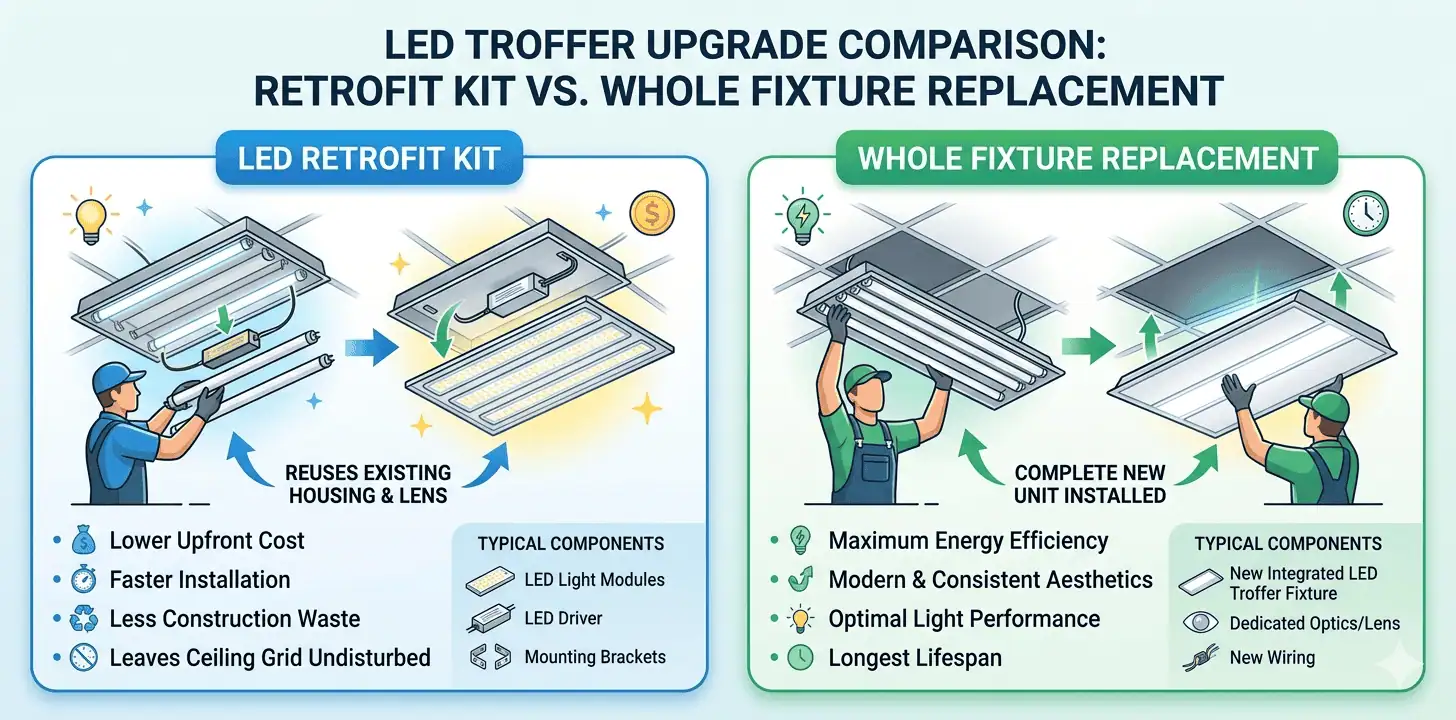
A troffer retrofit kit, sometimes called an LED troffer conversion kit or linear LED retrofit, is exactly what it sounds like. You keep the existing sheet metal housing in your ceiling grid and install an LED panel, driver, and diffuser into it. The old fluorescent tubes and ballast come out; the new LED components drop in. The housing stays put, the ceiling stays intact, and your disruption is minimal.
A full fixture replacement involves removing the entire troffer from the ceiling grid, including the housing and wiring, and installing a brand-new LED troffer. It replaces the old system completely, delivering a modern lighting solution built for long-term performance.
You get a clean, purpose-built lighting solution with a manufacturer’s warranty covering every component. With LED-optimized optics and no legacy hardware left behind, performance, reliability, and long-term value all improve. Both approaches eliminate fluorescent lamps and ballasts. The question is what you leave in the ceiling once the job is done.
The Real Cost Comparison for Ontario Buildings
Let’s use a realistic example: a 150-fixture office building in Markham running 2×4 T8 fluorescent troffers. The fixtures are 15–20 years old, which describes a significant percentage of commercial inventory across the GTA right now.
A retrofit kit for a standard 2×4 troffer runs $40–$90 per unit in Ontario in 2026, depending on wattage and colour temperature options. Labour for a clean retrofit install runs roughly $20–$35 per fixture when done in volume. Total installed cost for your 150 fixtures: approximately $9,000–$18,750.
A full fixture replacement, a quality LED troffer, not a bargain-bin import, typically runs $80–$180 per unit, with labour in the $25–$45 per fixture range for a batch project. Total installed cost for 150 fixtures: approximately $15,750–$33,750.
That gap looks significant. But before you default to retrofit, ask one question: what condition is the housing in?
A 20-year-old troffer housing was never designed for LED optics. The reflector geometry, diffuser material, and thermal characteristics were engineered around a fluorescent source.
Fitting an LED kit into that housing gives you decent energy savings, but rarely gives you the uniform, glare-free light distribution that a purpose-built LED fixture delivers.
If your space is client-facing, a law firm in downtown Toronto, a medical clinic in Burlington, a retail showroom in Vaughan, that visual difference is noticeable. Tenants and clients notice it even if they can’t name what they’re seeing.
New LED troffers use 50–70 watts, replace 128-watt fluorescents, and deliver better efficiency and lumen output than retrofit kits.
At Ontario’s commercial hydro rates, around $0.12–$0.16/kWh blended in 2026, that efficiency gap adds up to real money. A 150-fixture building making the full switch could see annual energy savings of $6,000–$10,000 compared to fluorescent.
The payback period on the full replacement over retrofit, accounting for that performance difference, often lands under 4 years.
Also read: How Metal Halide to LED Retrofit Conversion Kit – Save Up to 75% Energy
Why People Default to Retrofit (And Why It’s Understandable)
The retrofit pitch is simple: less money upfront, no ceiling disruption, faster installation. For a building owner who just wants the fluorescent hum to stop and the hydro bill to drop, that sounds like a complete solution.
There’s also a real concern about installation complexity. Pulling old troffers out of a ceiling grid, especially in occupied spaces, especially in buildings with older wiring that hasn’t been touched in years, adds variables. What if the ceiling tiles crack or the grid needs adjustment?
What if the wiring at the junction box needs updating to current Ontario Electrical Safety Authority standards? These are legitimate questions, and they make the retrofit feel like the safer, simpler path.
If your building is occupied 9-to-5 and scheduling after-hours electrical work means paying premium labour rates, that cost difference between retrofit and full replacement widens further. For a small owner-operated building in Barrie or Sudbury where every dollar of capital counts, that matters.
What Changes When You Replace the Whole Fixture
- Before a full replacement: a ceiling full of aging housings with inconsistent reflector condition, retrofit kits that perform well but never quite look right, ongoing concern about whether the 20-year-old housing is contributing to heat retention, and the knowledge that at some point, the housing itself will fail even if the LED components are fine.
- After: a uniform ceiling. Every fixture is a fully integrated system with matched optics, a single manufacturer warranty, and one clear point of accountability. If issues arise, support and maintenance are far simpler to manage.
The light distribution is even and purposeful. Maintenance becomes straightforward, if a fixture fails, you replace the fixture, full stop. There’s no sorting through which component of a hybrid kit assembly is the problem.
Also read: Lighting Audit Questions Every Facility Manager Should Ask
From a building management standpoint, a complete fixture replacement also gives you a clean asset record. New troffers, installed with documentation, with full ESA inspection compliance, with manufacturer warranties running 5–7 years on the fixture itself.
That matters when refinancing, attracting cost-conscious tenants, or managing maintenance schedules with greater predictability and long-term operational control.
Why 2026 Specifically Makes This Decision Urgent
The commercial real estate market in Ontario has shifted in a way that makes lighting quality a competitive factor, not just an operational one. Hybrid and flexible work arrangements have pushed tenants to be more selective about physical workspace quality.
Buildings across the GTA, Hamilton, and Kitchener-Waterloo that have completed LED upgrades are seeing stronger lease renewal conversations. Tenants may not ask about lighting directly, but brighter, more comfortable spaces create a better experience that supports retention.
At the same time, Ontario’s Save on Energy rebate programs continue to offer per-fixture incentives on qualifying LED upgrades, but these programs require pre-approval and are subject to annual funding availability.
Several Ontario utilities have already tightened eligibility criteria in 2025 and early 2026. Waiting another year means a real chance of losing $1,500–$5,000 in rebate value on a mid-size project.
Finally, fluorescent lamp supply in Ontario has continued to tighten following global phase-out commitments. Facilities that haven’t converted are already experiencing longer lead times and higher costs for replacement T8 fluorescent tubes. The maintenance cost of staying fluorescent is rising, quarter by quarter.
Who Should Stick With Retrofit Kits
A retrofit kit is genuinely the right call in a few specific situations. If troffer housings are under 10 years old, corrosion-free, and budget is tight, quality retrofit kits deliver strong performance cost-effectively. Buildings in this category do exist, particularly in newer suburban commercial parks in Ajax, Pickering, or Oakville.
If you’re managing a short-term tenant situation with a renovation planned in 18 months, a retrofit can be a smart interim solution. It delivers energy savings now without investing heavily in fixtures you may replace during the full renovation.
If ceiling integrity is a concern, especially in older suspended grid systems or heritage buildings, retrofit kits can be the practical choice. They keep the project contained, reducing disruption and avoiding added costs tied to ceiling tile or structural work. Outside those scenarios, full replacement is the better investment.
Your Next Step Is Simple
If you manage a commercial, industrial, or multi-unit property in Ontario with fluorescent troffers, a comprehensive lighting audit will tell you exactly which path makes sense for your specific fixtures, with real numbers, not estimates. Most audits take an hour or less and typically cost nothing.
You’ll receive fixture-by-fixture recommendations, projected energy savings, and insight into available rebate eligibility. Reach out to Faraday for a free on-site assessment before your next hydro bill arrives. This LED Troffers comparison is worth having on paper before you commit to anything.