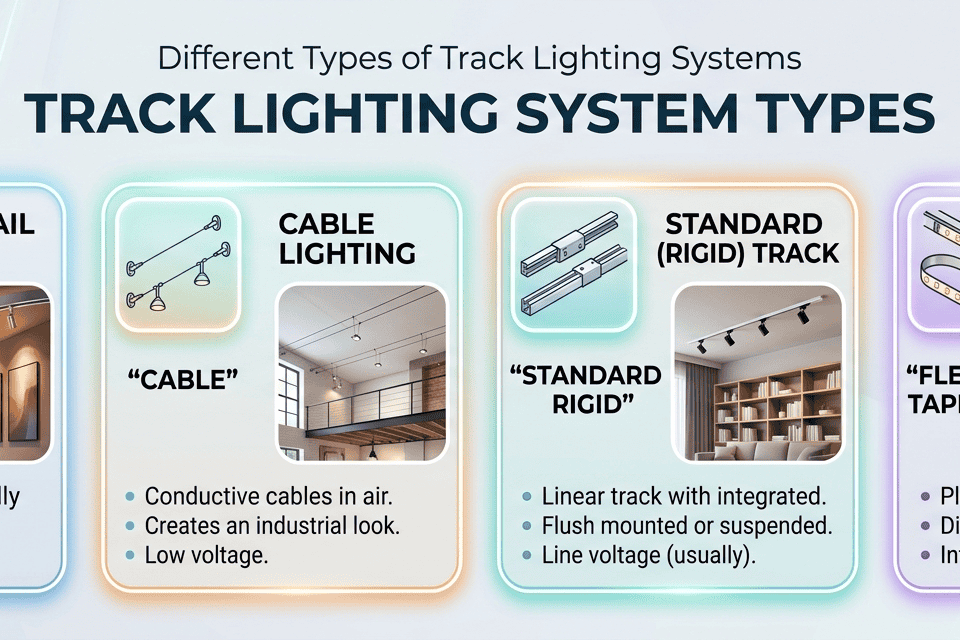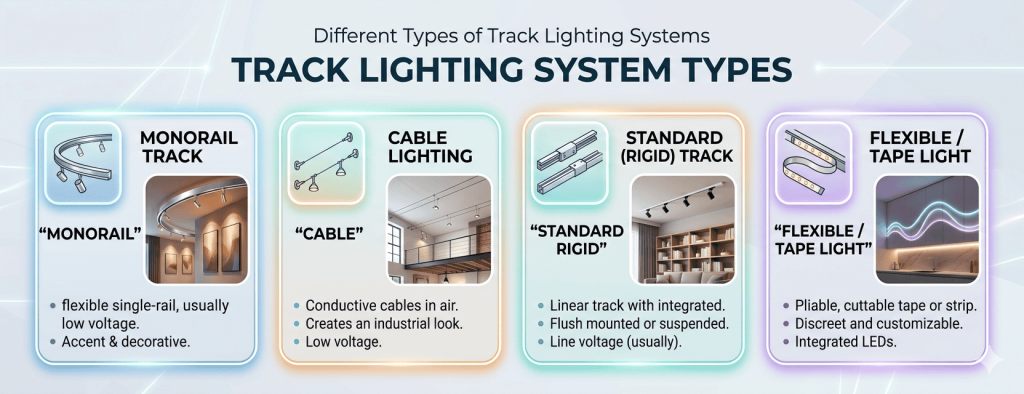
Different Types of Track Lighting Systems
May 19, 2026
The burnt-out wall pack above your loading dock has been dark for three weeks. You submitted a maintenance request. It got delayed twice. Now your night shift workers walk through a dark section of pavement using phone flashlights. You’re waiting for either a replacement fixture or a slip-and-fall report to arrive first. This is when exterior lighting becomes a real business problem. It stops being a line item in a brochure. At 11 p.m. on a Tuesday, an unlit property creates safety concerns, liability risks, and frustrated tenants or staff.
Choosing the Right Exterior Lighting for Commercial and Industrial Projects (2026 Guide)
For Ontario commercial and industrial properties in 2026, exterior lighting is no longer just maintenance. It affects safety compliance, insurance exposure, operating costs, and customer experience. Choosing the right fixture the first time prevents repeated service calls and costly mistakes.
Start with the Application, Not the Fixture
Many Ontario facility managers make the same mistake. They start with a fixture catalog instead of the property layout. They find a low-cost wall pack, order twelve units, and install them everywhere. Later, they realize several areas needed flood lighting instead. Others create glare complaints because fixtures spill light onto neighbouring properties.
Start by mapping your exterior zones first. Define what each area needs to do and how much light it requires. A parking lot needs different coverage than a loading dock. A building entrance has different requirements than a secured yard fence line.
Ontario exterior lighting projects should also align with Illuminating Engineering Society (IES) standards and municipal bylaws. Some insurance policies require minimum light levels for walkways and parking areas. Those requirements should guide the fixture plan before any purchase decision happens.
LED Wall Packs: Perimeter and Exit Lighting
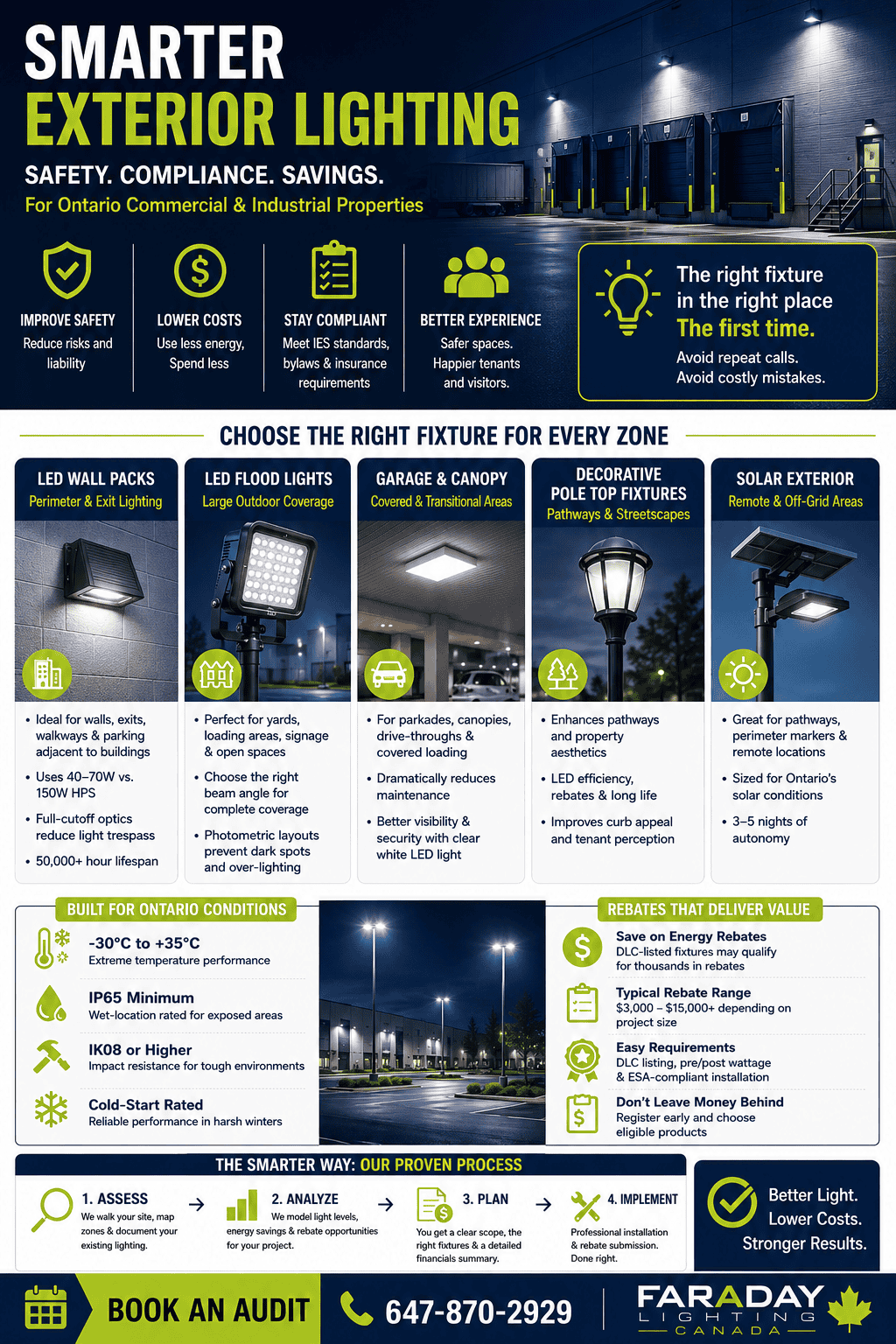
Wall packs remain the most common commercial exterior fixture. They mount directly to building walls and illuminate walkways, exits, service entrances, and nearby parking areas.
Most newer Ontario properties already use LED wall packs. Older industrial buildings and retail plazas often still rely on HPS or metal halide systems. Those outdated fixtures increase both energy and maintenance costs.
A 150W HPS wall pack running dusk-to-dawn can cost roughly $90–$100 annually per fixture at current Ontario commercial hydro rates. An equivalent LED wall pack usually operates between 40W and 70W. That lowers annual operating costs to roughly $24–$42 per fixture.
Maintenance costs also drop significantly. HPS lamps often fail within 2–3 years because Ontario’s freeze-thaw cycles stress the internal components. LED fixtures rated for 50,000+ hours can eliminate lamp replacements for a decade or longer.
Modern LED wall packs also improve light control. Full-cutoff optics direct light downward and reduce light trespass. That matters for properties near residential zones where municipal bylaws may restrict glare and spill light.
LED Flood Lights: Large Outdoor Coverage
Flood lights handle areas where wall packs cannot provide enough reach. They work well for outdoor storage yards, loading zones, signage, and open industrial spaces.
The most important flood light specification is beam distribution. Symmetrical floods spread light evenly across an area. Asymmetrical distributions push light farther in one direction. That works better for perimeter fencing and long rectangular yards.
Poor flood light placement creates dark gaps between fixtures. Those shadows increase theft risks and create safety concerns for employees and visitors.
This is why photometric planning matters. A lighting layout should model how light spreads across the actual site before installation begins. Without that step, many properties either under-light critical zones or overspend on unnecessary fixture counts.
Garage and Canopy Fixtures
Parking garages, drive-throughs, fuel canopies, and covered loading areas face unique environmental conditions. These spaces experience humidity, temperature swings, and long operating hours. Fixture access can also be difficult once installed.
LED canopy fixtures dramatically reduce maintenance compared to fluorescent or HPS systems. Traditional fixtures often require frequent lamp replacements in tight spaces with limited equipment access. A 50,000-hour LED canopy fixture can operate for more than a decade before major maintenance becomes necessary.
LED lighting also improves visibility and security. White LED illumination makes faces, licence plates, and security footage much clearer than yellow-toned HPS lighting. That improves tenant comfort and supports better surveillance performance.
Decorative Pole Top Fixtures
Not every exterior lighting decision focuses only on function. Retail plazas, campuses, hospitality properties, and mixed-use developments also care about appearance.
Decorative pole top fixtures provide pathway illumination while supporting the property’s visual identity. In competitive retail corridors, exterior lighting affects how customers and tenants perceive the property before they even enter the building.
LED decorative fixtures still deliver the same operational benefits as other LED categories. They reduce energy use, qualify for rebates, and minimize maintenance requirements. However, appearance becomes equally important alongside light performance.
Ontario’s Climate Changes the Requirements
Ontario weather is hard on exterior lighting systems. Fixtures must survive freezing winters, humid summers, and constant thermal cycling.
For exposed locations, IP65 should be considered the minimum wet-location rating. Impact resistance ratings like IK08 also matter in loading docks and service yards where accidental equipment contact is possible.
Cold-temperature performance is equally important. Some fixtures struggle to start reliably in unheated environments during Ontario winters. Proper fixture selection prevents these failures before they become maintenance problems.
Solar Exterior Lighting: Where It Makes Sense
Commercial solar lighting has improved significantly in Ontario. It works well for pathways, perimeter markers, and remote parking areas where trenching electrical lines would be expensive.
However, Ontario receives less winter sunlight than many western provinces. December and January provide limited charging opportunities, so battery capacity and panel sizing become critical.
For properties with easy electrical access, wired LED systems usually remain the more reliable long-term option. Solar lighting works best for remote applications or new developments where electrical infrastructure has not yet been installed.
Ontario Rebates for Exterior LED Upgrades
Many DLC-listed LED fixtures qualify for Ontario energy rebates through Save on Energy programs. Eligible products often include wall packs, flood lights, canopy fixtures, and decorative pole fixtures.
Depending on project size, commercial properties may recover thousands of dollars through rebates. Larger exterior upgrades can realistically capture $3,000–$15,000 in incentives.
Many property owners lose rebate eligibility by purchasing non-DLC-listed fixtures or failing to register projects before installation begins. Proper planning protects those savings.
When to Delay a Full Upgrade
Not every property should replace its entire exterior lighting system immediately. If a major renovation, resurfacing project, or site expansion is planned within the next 18 months, it often makes more financial sense to combine lighting work with that larger project.
Likewise, if only one or two fixtures have failed within an otherwise modern system, targeted repairs may be the smarter option.
Where to Start
If your exterior lighting system is more than ten years old, still uses HPS or metal halide fixtures, or generates constant maintenance calls, start with a full lighting assessment. A proper assessment maps your lighting zones, documents current fixture performance, and calculates energy savings, rebate opportunities, and replacement costs before any purchasing decisions happen.
You can explore commercial exterior lighting solutions through Faraday Lighting.