Why IoT Lighting Matters for Commercial, Residential, and Retail Spaces (2026 Guide)
May 8, 2026
How to Choose the Right Exterior Lighting for Business
May 22, 2026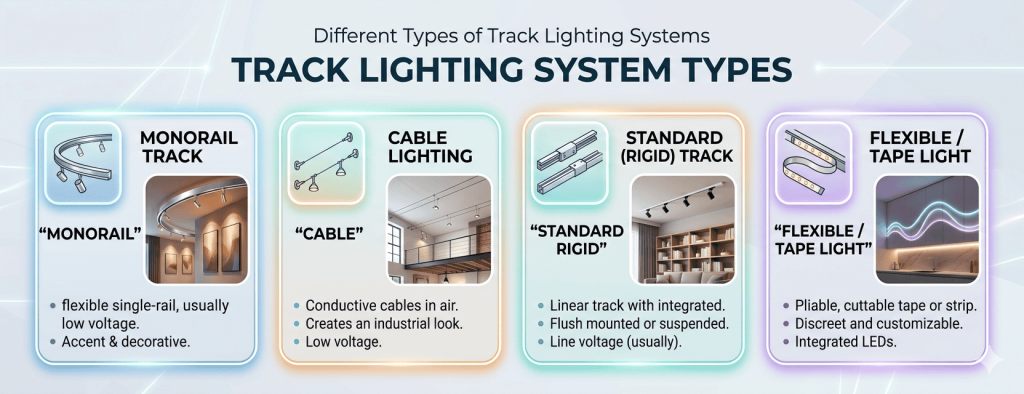
You walked into a showroom or office last month and immediately noticed how much cleaner, brighter, and more professional the space felt. The products were similar, and the layout hadn’t changed much, but the lighting completely transformed the experience. The merchandise stood out, the reception area felt more welcoming, and the entire space had a visual flow your current setup lacks. They were likely using one of the different types of track lighting systems designed to direct light intentionally and highlight key areas. Meanwhile, you may still be relying on standard recessed fixtures that spread light evenly across a space that actually needs focused, layered illumination instead of a flat, uniform glow.
Track lighting is a decision that on its face seems to be deceptively simple, but quickly becomes very complex. There are numerous track systems, numerous heads, and a compatibility chart that most Ontario businesses and landlords find quite confusing to design on their own. This article provides an in-depth guide with no jargon or overload so you can make an informed decision about your own space.
Why Track Lighting Systems Gets Chosen in the First Place
Before getting into system types, it’s worth being clear about what track lighting actually does that other fixtures don’t. Standard recessed fixtures, flat panels, and troffers deliver ambient light. They illuminate a room uniformly. That’s the right solution for a warehouse floor, a hospital corridor, or a back-office workspace. But in retail, hospitality, galleries, auto dealerships, and higher-end commercial interiors, uniform light is often a problem. It creates flat, lifeless lighting that fails to draw attention to products, artwork, or key focal areas, making even premium merchandise feel uninspiring.
Track lighting solves this by separating where the electrical supply runs from where the light points. You install one track and easily reposition or aim the lights wherever you need focused intensity or wider coverage as displays change. It’s a fundamentally different approach to how light gets distributed in a space.
The question isn’t whether track lighting is right for your category of space, for most retail, hospitality, dealership, and commercial office applications, it almost certainly is. The question is which system type fits your ceiling, your electrical setup, and your operational needs.
4 Main Types of Track Lighting Systems Used
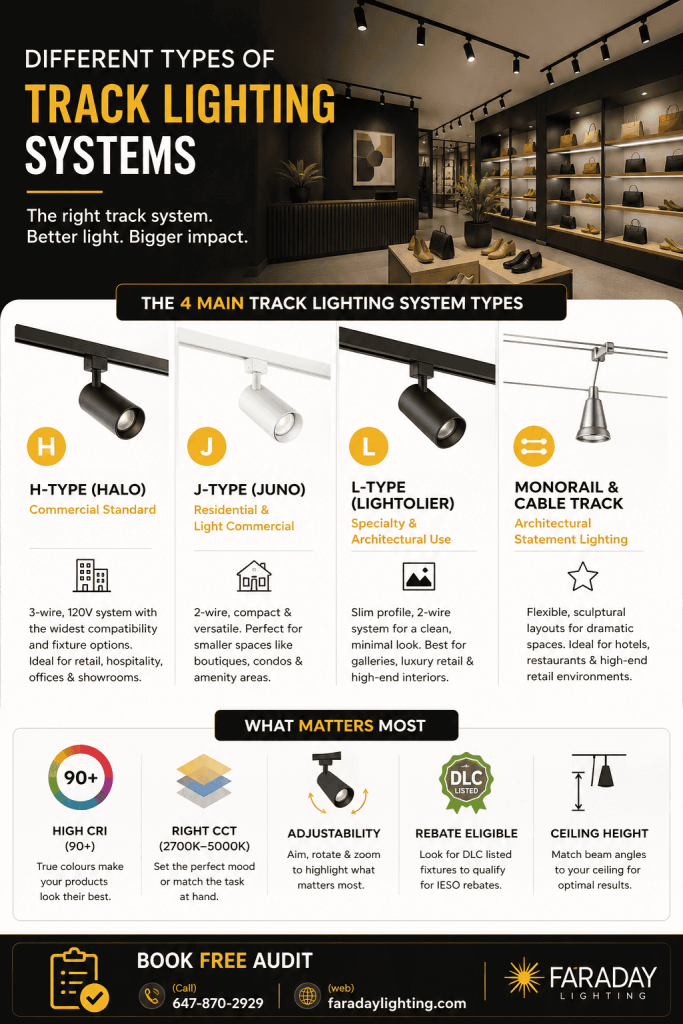
1. H-Type (Halo) Track – The Commercial Standard
H-type track, commonly called Halo track, is the most widely used system in Canadian commercial applications. Its 3-wire, 120V design connects directly to standard North American electrical systems without requiring additional transformers or adapters.
The reason H-type dominates commercial spaces is compatibility. Because it became the de facto standard across North America, the fixture ecosystem is enormous. You can source heads, pendants, and accessories from multiple manufacturers and have them work on the same track. For Ontario property managers who want flexibility and long-term serviceability without being locked into one supplier, this matters.
Faraday Lighting’s RENO Track Lighting is built on the H-type (Halo) system. The RENO STORY Series zoomable cylinder heads are compatible with H-type track, run at 120V, and deliver 1,800 lm at 20W or 2,700 lm at 30W with a CRI greater than 90. A CRI above 90 helps retail lighting display colours accurately, so products appear vibrant, natural, and visually appealing.
These same RENO heads provide you a beam angle adjustable from 20° to 50° with 350° rotation and 180° tilt. One adjustable fixture can deliver either focused spotlighting or wider display coverage without replacing the track head. A retail floor or an auto showroom that rearranges displays on a seasonal basis will avoid having to re-spec everything from scratch every time the merchandising changes when they use this built-in adaptability.
2. J-Type (Juno) Track-Residential & light commercial
J-type is a 2-wire system that is more common in residential or light commercial installations, but will generally not handle the same loads or has the same broad fixture family available at the commercial level as the H-type. This type may be the correct option when setting up a smaller shop in a Yorkville strip mall, or even a high-rise condo amenity space in Mississauga; they generally tend to be smaller and available in more finishes.
However, spaces with high ceilings or future higher-wattage needs may outgrow this system and limit expansion flexibility. Unless you plan to keep the space strictly residential, H-type track offers better long-term compatibility and higher load capacity.
3. L-Type (Lightolier) Track – Specialty and Architectural Use
L-type track features a slim profile often used in architectural spaces and high-end retail environments for a cleaner visual appearance. Its proprietary 2-wire connector system limits compatibility to fixtures specifically designed for L-type track.
Where L-type shines is in spaces where ceiling aesthetics matter as much as light output. Its slim, low-profile design blends into gallery-style and luxury retail spaces without distracting from the displays. In Toronto’s design district or higher-end Yorkdale tenancies, you’ll see L-type used precisely because it disappears into the ceiling.
The trade-off is flexibility. If you need quick replacements or specific colour temperatures, L-type systems offer fewer compatible fixture options and less flexibility for future changes.
4. Monorail and Cable Track – Architectural Statement Lighting
Monorails and cable systems differ from the three types of track above. Traditional track lighting uses a ceiling-mounted powered rail, while monorail and cable systems deliver power through suspended conductors or tensioned wires. This enables more varied, curved, eccentric or sculptural arrangements of the track, whereas traditional track arrangements cannot accommodate any deviations.
Hotels, fine-dining restaurants, and luxury retail spaces often use these systems to make lighting part of the overall design. In the GTA, boutique hotels in the Entertainment District and upscale King West restaurants often use monorail lighting systems.
Cost and complexity are significantly higher. Monorail systems require custom fabrication, experienced installers who understand low-voltage power supply requirements, and usually an engineering design review for the electrical load. They’re not a DIY project, and they’re not appropriate for standard commercial spaces where budget efficiency matters. Most Ontario businesses and property managers choose between H-type and J-type track systems, while L-type suits select high-end spaces.
The Fixture on the Track Matters as Much as the Track Itself
Choosing the right track system is only half the decision. The head you put on it determines whether your space looks polished or just adequately lit. For commercial and retail applications across Ontario, two key specifications on track heads deserve your attention before anything else.
CRI (Colour Rendering Index): This tells you how accurately your fixture renders colours compared to natural daylight. A CRI of 80 is the minimum for most commercial spaces. A CRI of 90+ is recommended anywhere colour accuracy matters — retail, galleries, auto showrooms, food service. The RENO Track heads at Faraday carry CRI >90, which is the spec you want for anything customer-facing.
CCT (Colour Temperature): This is the warmth or coolness of the light, measured in Kelvin. 2700K–3000K produces warm white light suited to hospitality, restaurants, and retail environments where ambiance drives purchasing decisions. 4000K–5000K produces cool white better suited to task-heavy environments like service bays or back-of-house areas. The RENO series is available in 2700K, 3000K, 3500K, 4000K, and 5000K — so you’re not forced into a single temperature across a mixed-use space.
For spaces where you’re replacing older line-voltage PAR lamp track heads, Faraday’s UNI1190 is a practical universal cylinder fixture compatible with H-type track that accepts PAR lamps up to 150W with a medium base. Its front-loading design, adjustable aiming, and secure angle lock make it a reliable solution for existing track lighting systems.
Track Lighting and Rebates in Ontario
One question we receive constantly from homeowners in Ontario is, “Will my LED track lighting be applicable for Save on Energy rebates through the IESO program?”. The answer is; “Maybe”. It is really all about the specific fixture and if it has DLC certification.
Most Ontario rebate programs require DLC certification to verify that a commercial LED fixture meets approved efficiency and performance standards.
If you want to maximize rebate savings on a track lighting installation, start by confirming the fixtures carry DLC certification. A professional lighting audit helps identify these rebate requirements before installation, preventing costly specification changes later.
Faraday Lighting’s team manages rebate applications as part of our turnkey lighting solutions. Faraday Lighting manages the audit, product selection, installation, and rebate applications through one streamlined process.
Getting the Ceiling Height Right For Your Business / Showrooms
One thing Ontario property owners routinely underestimate is how ceiling height affects track head selection and placement. A track head that works well with 9-foot ceilings can cause harsh glare in 12-foot spaces without proper beam adjustment.
The general rule for accent lighting is a 30° beam angle for higher ceilings (12 ft+), widening as you move to lower mount heights. Faraday’s Light Level Simulations service produces photometric layouts that model how specific fixtures perform at your actual ceiling height before anything is ordered or installed. For retail stores and showrooms, proper lighting planning helps ensure products appear exactly as intended before installation begins.
If you’re still figuring out the broader picture of how different ceiling fixture types work together in your space, the How to Choose a Ceiling Light (Canada 2026 Guide) on the Faraday blog walks through ambient, task, and accent layering in detail — useful context if track lighting is one piece of a larger redesign.
When Track Lighting Seem NOT Right Option
Track lighting isn’t the answer for every space, and it’s worth being direct about where it falls short. If your space requires wide, even lighting coverage, warehouses and back offices benefit more from high bays or panel lighting systems. High bay fixtures or flat panel systems deliver better lumens per dollar for pure ambient coverage. Track is for spaces where directionality and flexibility matter more than raw lumen volume at the lowest cost per square foot.
Similarly, if your ceiling has significant structural constraints — low clearances, non-standard joist spacing, or complex mechanical interference, track installation can become expensive and complicated. A photometric review and electrical assessment upfront will tell you whether track is feasible before you commit to the product.
A Practical Next Step
Retail, hospitality, dealerships, and offices across Ontario use track lighting to replace flat, outdated lighting with focused visual impact. Choose the right track system, fixture specifications, and rebate-eligible setup to match your space, lighting goals, and installation budget.
Faraday Lighting offers a free facility assessment that covers exactly this: your current setup, the right system type for your space, fixture specifications, and rebate eligibility. It’s the fastest way to get from “I know we need better lighting” to a concrete plan with real numbers.
Explore full LED Track Lighting collection at Faraday Lighting or book your free audit at faradaylighting.com to get started.