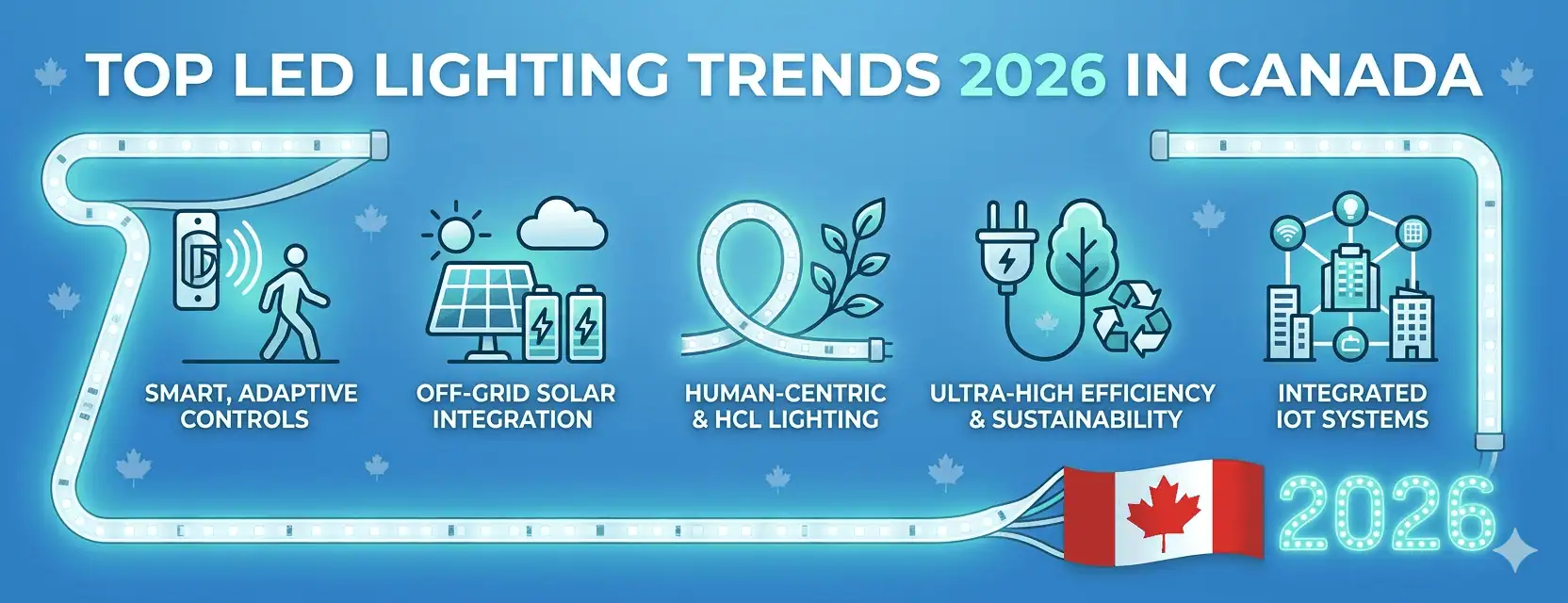
5 LED Lighting Trends That Are Shaping Canadian Spaces
May 8, 2026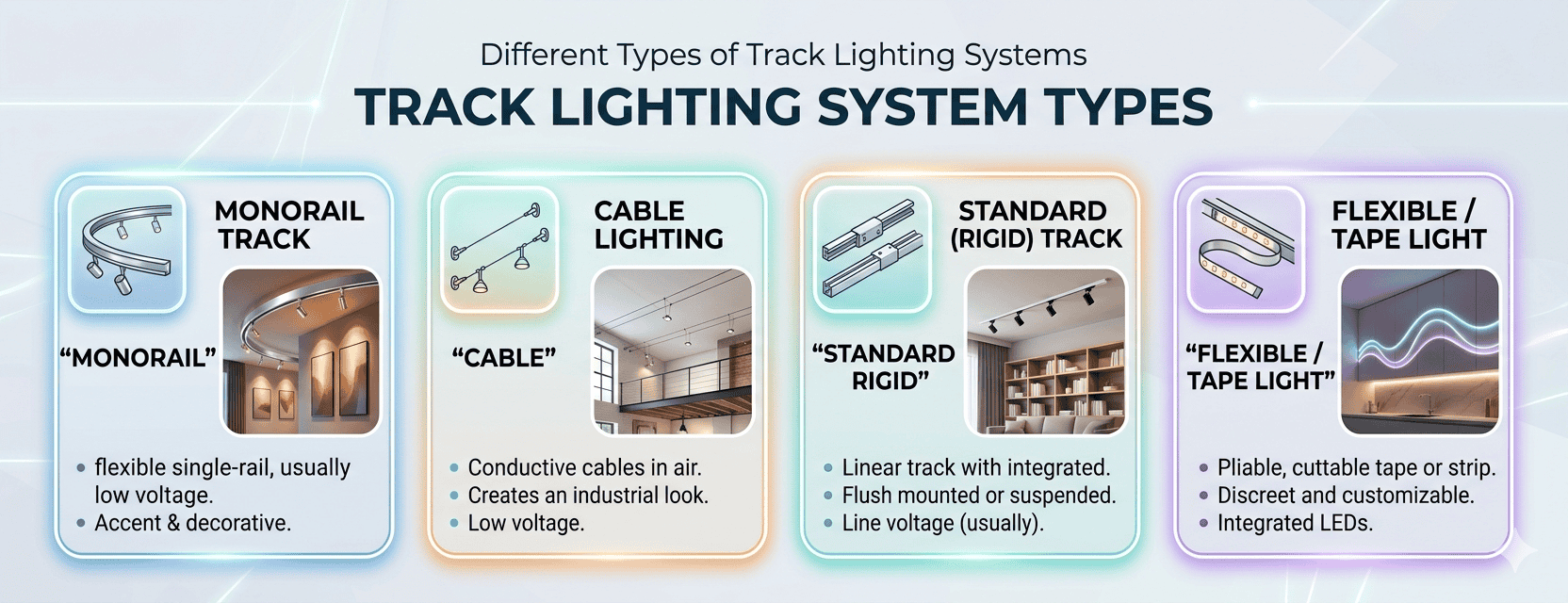
Different Types of Track Lighting Systems
May 19, 2026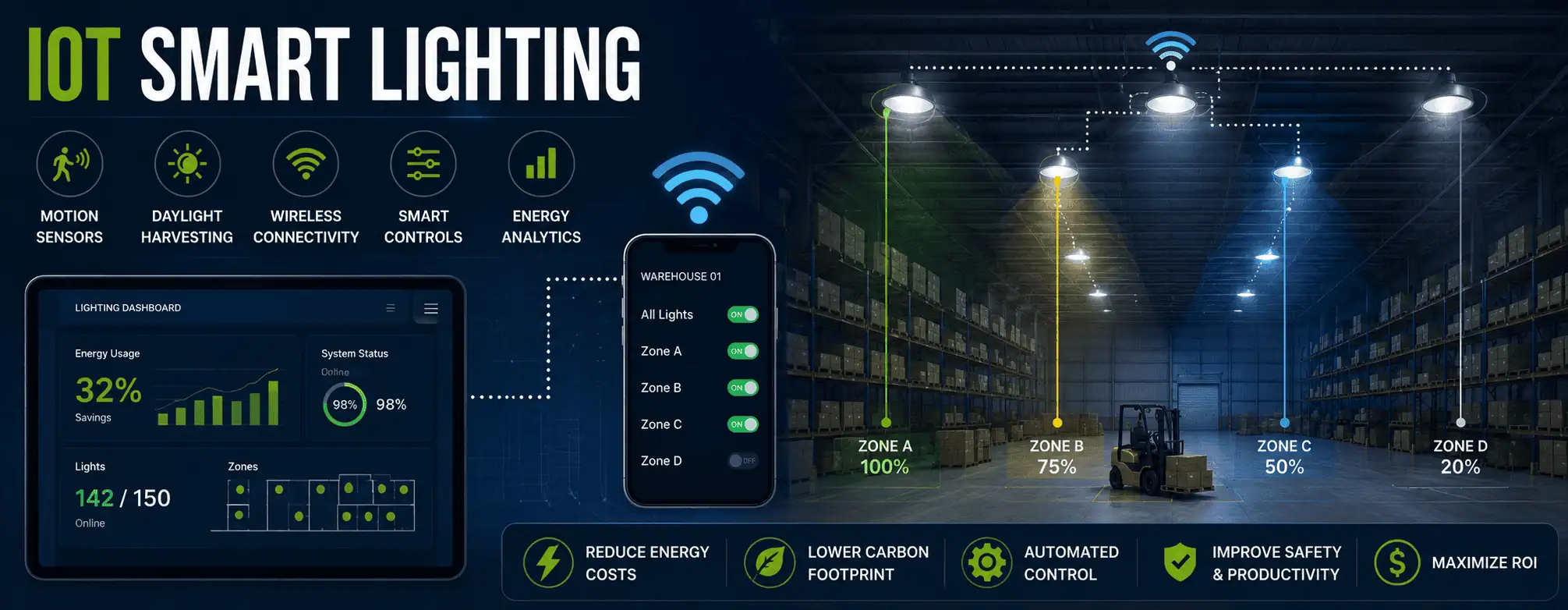
Your lights have been running at 100% since 6 a.m. It’s 2 p.m. on a Tuesday. Half your office is empty because half your team works hybrid. Your back storage room hasn’t had a person in it for four hours. Every watt burning in those empty spaces inflates a hydro bill that climbs regardless of your building’s actual occupancy. This is where IoT lighting is the answer. It doesn’t involve upgrading your fixtures. Transform your lighting into a system that senses and responds to real-time activity within your facility.
For Ontario business owners, property managers, and multi-unit residential operators in 2026, IoT-enabled smart lighting is not just an experiment in advanced technology. It’s a sound financial investment with a tangible payback, and in most cases it already qualifies for rebates under the IESO’s Save on Energy program.
Here’s what it actually looks like, where it delivers genuine value, and what to consider.
What IoT Lighting Really is, Beyond the Jargon
IoT stands for the “Internet of Things”, a term that spans from smart appliances in our homes to complex industrial systems. With lighting, it simply means having light fixtures and/or smart controls that are linked through a network. This allows them to send data back and forth from each other, from various sensors in the building, and from a central management platform.
- In an Ontario commercial or residential building, this practically involves one or more of the following elements.
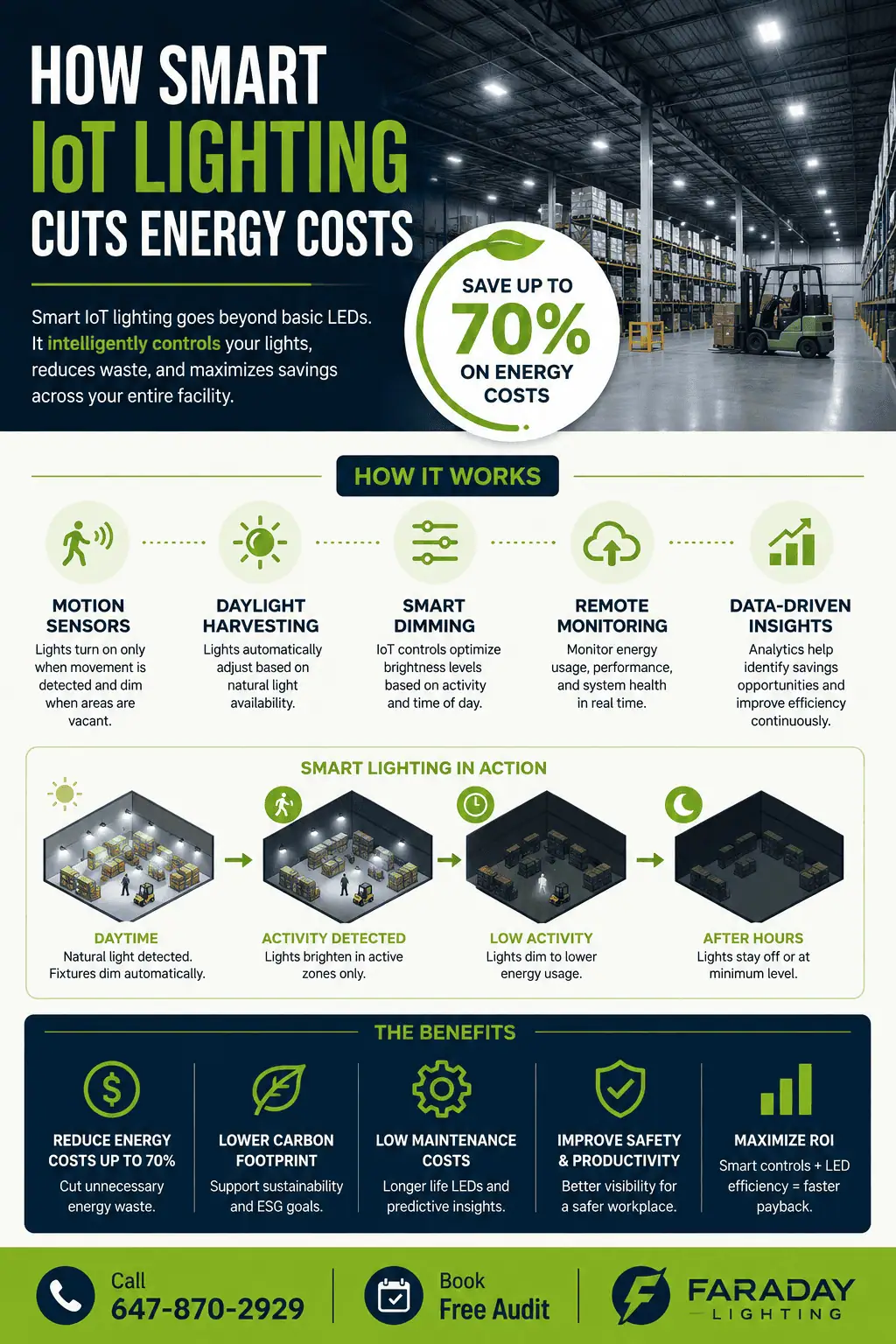
- Occupancy-based dimming-Lighting automatically dims down when the space is vacant.
- Daylight harvesting-The artificial lighting dims when sufficient natural light is available in the room or building.
- Scheduling-Lighting levels are reduced on a programmed schedule, typically when the building is unoccupied.
- Remote monitoring identifies and communicates fixture failures to facility staff before tenants need to report them.
- Energy dashboards-Detailed views show where significant electrical load is being consumed in each lighting zone.
Individually, none of this technology is revolutionary. What makes an IoT lighting system different from a simple timer or an occupancy sensor is integration. If your light fixtures, your sensors, and your controls all reside on the same network, they can coordinate decisions for your entire building instead of disparate zones.
For example, a hallway tied to a programmed night-reduction schedule can still respond to an occupancy sensor if a cleaning crew works late. Smart systems automatically dim retail storage aisles while keeping display areas bright, replacing manual wall panel adjustments by office attendants. The effect is a lighting system that acts more like a managed utility infrastructure than a series of on-off switches.
Why 2026 Is the Right Year to Pay Attention
The technology argument for IoT lighting has existed for a decade. The financial argument in Ontario became compelling about two years ago and is sharper now than it’s ever been.
Rising Ontario electricity rates make peak-period energy waste more expensive than ever for commercial facilities on time-of-use billing. Most Ontario facilities already have efficient LEDs; the next layer of savings comes from control, not just the fixture. And the cost of connected controls has dropped significantly as the technology matured and became more widely deployed.
A commercial office building in Brampton or Mississauga running standard LED fixtures without controls is typically drawing 80–100% of rated load across all zones, all business hours. Occupancy-based dimming and daylight harvesting typically reduce lighting energy use by 30–50% beyond initial LED upgrade savings. At Ontario’s current commercial hydro rates, that’s not a small number.
For a 20,000 sq. ft. office building spending $18,000–$25,000 per year on lighting electricity after an LED upgrade, a well-executed IoT controls layer can cut that figure by $5,400–$12,500 annually. Depending on installation complexity, payback periods run 18–36 months — in the same range as the LED upgrade itself.
What IoT lighting solutions are available for commercial buildings
IoT lighting offers the strongest financial case for GTA commercial and industrial properties due to predictable and varied occupancy patterns. Hybrid work leaves 30–50% of desks empty daily, yet lighting systems still follow outdated, pre-pandemic occupancy schedules.
Occupancy sensing at the zone or even desk-cluster level is the direct fix. Networked systems provide automatic, granular dimming based on real-time presence, replacing binary “on/off” switching for entire floors.
This is also where Faraday’s LED High Bay Fixtures with integrated sensor readiness matter. In warehouse and manufacturing environments, aisle occupancy can vary dramatically throughout a shift.
High bay fixtures with motion sensor integration and 1-10V dimming compatibility — like Faraday’s UFO and linear high bay series — can hold unoccupied aisles at 20–30% output and ramp to full brightness within seconds when someone enters. The energy profile across an 8-hour shift looks completely different from a system running full-tilt all day.
For facility managers thinking through this more systematically, this 14 Lighting Audit Questions Every Facility Manager Should Ask on the Faraday blog is a practical starting framework — it covers occupancy pattern analysis, zone mapping, and control compatibility questions that should happen before any IoT controls investment is specified.
Retail Spaces: IoT Lighting as a Customer Experience Tool
In retail, IoT lighting serves two key purposes beyond just saving energy. The savings are significant; a GTA retail space can generally reduce lighting energy use by 25 to 40% with a well-designed control system. However, the impact on customer experience is equally important and often overlooked.
Connected lighting systems can be set to change color temperature and brightness throughout the day. A clothing retailer might use warmer, dimmer lighting in the morning to create a welcoming atmosphere as the store opens. At midday, when customer traffic peaks and products need to appear at their best, the lighting can shift to brighter, cooler tones. In the evening, it can revert to a warmer, more relaxed ambiance. These changes are not done manually.
They are pre-set scenes that run automatically based on the time of day. Store managers can adjust them using a tablet or phone. The result is a space that feels intentional and vibrant rather than bland and institutional. An LED Track Lighting is the fixture type most commonly paired with scene-based IoT controls in retail. Central systems enhance adjustable heads by managing output levels and color temperature alongside directional flexibility. Faraday’s RENO Track Lighting series supports 120V TRIAC dimming, which makes it compatible with the dimmer-side of most modern lighting control systems without requiring proprietary drivers.
For retailers who’ve invested in the right fixtures but are still running them on a flat always-on schedule, IoT controls are the layer that makes that investment perform at its ceiling.
Multi-Residential Buildings: Reducing Operating Costs Across Common Areas
IoT lighting in multi-residential properties — condo towers, rental apartment buildings, senior living facilities — is primarily a common area story. The suites themselves are tenant-controlled. But hallways, stairwells, parkades, amenity rooms, lobbies, and laundry rooms run 24 hours a day, every day of the year, regardless of whether anyone is using them.
For a property manager running a 200-unit building in the GTA, those common area lighting costs are a real line item in operating expenses. A typical 200-unit mid-rise spends $8,000–$14,000 annually on common area lighting electricity, depending on building age and fixture type.
Occupancy sensors, daylight harvesting, and scheduled dimming collectively reduce common area lighting loads by 40–60%. The LED Flat Panels with sensor-ready compatibility in corridor applications, LED Wall Packs with photocell controls on exterior entrances, and Garage & Canopy Fixtures with motion sensor integration on parking levels are the fixture categories where this occupancy-based logic has the clearest application.
Saving common area operating costs directly improves your NOI or provides much-needed breathing room within your current operating budget. In a market with pressured cap rates and high financing costs, pursuing operational efficiency through lighting improvements is essential.
IoT Lighting Can Gets Wrong When Poorly Implemented
IoT lighting is not a plug-and-play technology. The failure modes are real, and they’re worth understanding before you commit budget.
The most common problem is system fragmentation — buying sensors, controls, and fixtures from different vendors whose protocols don’t communicate cleanly. You end up with a system that works in theory but requires constant manual intervention because the components don’t actually coordinate the way the spec sheet implied. This is particularly common when procurement is driven purely by unit cost rather than system integration planning.
The second problem is over-automation without override. A stairwell that dims to 10% because no one has been in it for five minutes sounds efficient — until someone walks in and spends two seconds in darkness waiting for the sensor to respond. Poor sensor placement, inadequate response speed, or insufficient minimum output thresholds create spaces that feel unreliable and frustrate occupants.
Both of these problems are solved at the design stage, not during installation. An engineering design services that account for sensor placement, protocol compatibility, and zone logic before any equipment is ordered are what separate a well-functioning IoT lighting system from an expensive headache.
Getting a Lighting Audit and Analysis before specifying controls also matters here — it establishes baseline occupancy patterns and existing control infrastructure, which determines which IoT layer makes sense for your specific building rather than a generic recommendation.
IoT Lighting and Ontario Rebates
Ontario’s Save on Energy program increasingly rewards connected controls, occupancy sensors, and networked dimming alongside LED upgrades. Fixture types, control measures, and DLC certification status determine the value of your lighting retrofit rebates in Ontario.
What this means practically: if you’re planning an IoT controls layer as part of a broader LED upgrade. Specifying DLC-listed fixtures with compatible control protocols from the outset significantly increases your total rebate capture versus separating projects. Faraday Lighting’s Turnkey Lighting Solutions service manages rebate applications as part of the project — which matters because the documentation requirements for controls rebates are more involved than for straight fixture swaps.
If you’re wondering how to read occupancy data during the audit phase to size the controls investment correctly, the10 Reasons Businesses Are Switching to Motion-Activated Lighting blog covers the operational mechanics in useful detail — a good complement to the financial case made here.
Who IoT Lighting Is NOT Right For
If your building already has high, consistent occupancy throughout its operational hours, a busy manufacturing floor running two full shifts, a grocery store where the space is always occupied during business hours, or a school with a predictable bell-schedule occupancy, the marginal savings from occupancy-based IoT controls are smaller. The control cost may not pencil out against the energy savings alone.
Fix the base layer first if your current lighting infrastructure is poor or fixtures are pre-LED. Putting a sophisticated controls layer on inefficient metal halide or fluorescent fixtures is the wrong sequence. Complete the LED retrofit, establish baseline consumption, and then evaluate where controls make financial sense.
A Practical Starting Point
IoT lighting delivers peak performance when you design it from the system level down, rather than assembling it from the components up. Conduct a facility assessment for Ontario properties to map occupancy patterns and electrical infrastructure before making product decisions.
Faraday Lighting offers a free facility audit covering exactly that scope — current energy draw, occupancy analysis, fixture compatibility with smart controls, and rebate eligibility. It’s the starting point that turns “I know we should look at IoT lighting” into a concrete project with real numbers and a defensible payback period. Get in touch with Faraday team to book your free assessment or explore the full product and services range.
Frequently Asked Questions
1) What lighting trends are Canadians actually going for in 2026?
Canadians are leaning toward lighting that feels warm, practical, and a little more personal. Think clean-lined fixtures, smart controls, and layered light that makes a room feel comfortable instead of overly bright or clinical.
2) Is smart lighting still worth it in 2026?
Yes, and it’s becoming more of a normal upgrade than a luxury. People like that smart lighting makes it easy to dim, schedule, and adjust light without changing the whole setup.
3) What color of light feels best in Canadian homes?
Warm white is still the favorite for living rooms, bedrooms, and other spaces where people want things to feel cozy. Cooler light suits task areas like kitchens and offices, but most people prefer a softer look at home.
4) Are statement lights still in style, or is everything going minimalist?
Both are in style, which is why 2026 feels more interesting. Many Canadian spaces mix simple, understated fixtures with one bold, sculptural pendant or standout floor lamp to add personality..
5) What’s the easiest way to make older lighting feel more modern?
Start small with dimmers, better bulbs, or a fixture swap in one main room. Even one change, like replacing a dated ceiling light with something cleaner and more current, can make the whole space feel updated.
6) Why are layered lighting setups getting so much attention?
Because one overhead light usually isn’t enough anymore. People want a mix of ambient, task, and accent lighting so rooms feel more comfortable, flexible, and lived-in.
7) What lighting trends work best for Canadian weather and winters?
Warm, cozy lighting tends to matter more in Canada because long winters make indoor spaces feel even more important. Soft lighting, adjustable brightness, and brighter task light in key areas can help a home feel inviting through the darker months.